6 Impacts of Smart Schools on Education

6impacts
 
The face of education for the past decade has undergone many changes and most of it can be attributed towards the advent of the smart school. The jury is still out on whether or not 21st century illiterates should be learning the modern ways of communication and expression, but most schools are adapting to hire educators who are well versed with technology and can help students learn technology in the most efficient and beneficial way. If you would do a google search on “smart school”, you will either find various smart school softwares or how a school is graded as a smart school based on students’ performances in public examinations.  Let’s first define what a smart school is and through that we can begin to understand its impact on education.
 

What is a Smart School?

 
A smart school could easily be defined as a school which incorporates the latest technologies to organize, accommodate and optimize the student learning process. This could involve using the latest ideas of blended learning, the flipped classroom, BYODs and other such practices. The 21st century has seen a lot of development in technology at an exponential rate, which has lead to technology being accessible very easily. A smart school need not even be physically present to be a school, one could host classrooms online using the help of various Learning management systems and haven’t have the need of owning a classroom at all. The smart school also incorporates all the softwares it can to help in the management and the learning of it’s students.
 

Smart School and it’s Impact on Education

 
Books and pens have been replaced with touch screen in this day age, be it at work or for leisure. But with the Occulus Rift coming out early next year, it would seem that Virtual reality would be the new face of education and learning. Virtual reality could be used to teach and provide a great environment for children and students of all ages taking the school from being more than just a smart school. Let’s discuss the impacts the smart school is already having on education:
 

  • Schools no longer need to maintain ledgers and cumbersome paperwork as every smart school software now helps maintain all records for the school in one place.
  • Schools no longer need to worry about stationary as pens and notebooks are slowly being replaced by tablets and computers.
  • Being a smart school allows the educators to reach out to students all over the world and develop thriving online learning communities.
  • Students in a smart school are exposed to students from other parts of the world via online meetings and collaborations.
  • Smart school softwares include functionalities of an ERP and LMS making it really simple for any school to run and maintain processes.
  • Schools now have the option of storing all their data on the cloud and stop worrying about lost data and the time consumed to retrieve it.

 
The 21st century education landscape is shaping up to be a global village and most of it can be attributed to all the smart schools coming up in the world right now.

 

The Benefits of Scheduling Software for Schools

SchedulingSoftware
 
The task of scheduling resources plays an important role in the overall success of an organization. As a result, it is necessary to exert sufficient effort and resources to the whole process of scheduling. Scheduling software is becoming the preferred method of keeping an organization’s schedules and appointments organized.
 
A school is one of the major institutions that heavily requires the use of a scheduling software. Working in a school can prove to be very stressful: you don’t need to complicate it further. If you are still using excel or pen and paper in your scheduling, you are definitely wasting precious time that would have been otherwise channeled in another area. Make the wisest choice by using the scheduling software.
 
Why You Need to Choose the Scheduling Software over Other Avenues
 
To begin with, the scheduling software system provides a faster and easier scheduling process. Organising hourly shifts for teachers and timetables has never been made easier. With the scheduling software technique; it only takes a few minutes to come up with a teacher’s schedule together with the perfect timetable.
 
The scheduling software also allows you to monitor the attendance of your staff. To top it up, the software allows you to see who came in late during their shift.
 
From a business perspective; the scheduling software is a tool that enhances the overall efficiency of your school which further reduces your costs. How is this possible? Scheduling software is a powerful tool that eliminates irrelevant costs of double booking, full reporting and utilization monitoring.
 
With the scheduling software, it is now possible to access scheduling work stations anywhere and at anytime of the day. You can simply do it on your laptop, smartphone or tablet.
 
Human is to error but with the scheduling software it is possible to operate on a zero defect standard. If one forgets to fill in a shift or overbook, the software immediately notifies you of the error.
 
Last but not least, the software acts as a powerful tool that can be used in saving time. No more wasting time with manual scheduling procedures like excel or pen and paper.
 
Price of Scheduling Software versus Traditional Scheduling
 
Are you using a traditional scheduling system because you think it’s fairly cheap? What you don’t know is that the cost of traditional scheduling can prove to be very high. One needs to manage an expense of a dedicated receptionist, paper appointment book, a dedicated team for planning and organizing timetables plus the sales loss over various preventable mistakes.
 
After owning a scheduling software, the only expense required is that of maintenance which costs way less when compared against a traditional scheduling system. After cost evaluation what will be your preferred choice: is it going to be the traditional scheduling system or the scheduling software system?
 
Final Verdict
 
To effectively govern a school and its micro demands; there needs to be meticulous order. There needs to be an environment where nothing misses the radar. Everything should be presented in a detailed order. This can only be done with use of ascheduling software. Scheduling is an art: for a masterpiece to be produced you need to have a professional artist. The scheduling software serves as your professional artists.
 

The What, Why and How of Database Software

The-What,-Why-and-How-of-Database-Software
 
Database software is a very tricky choice for any institution to make, if you are just starting out or are an existing institution. Often institutions find themselves in situations where they either have a huge amount of data and no database management software or have heavily invested in a database software only to find they won’t have any need of it. Institutions are also often guilty of storing their data in different places rather than in one single place, for example, student information ends up getting stored in the filing cabinet along with the teachers and the managing staff information. Parent communication and contacts ends up getting stored in the email providers like Gmail or Yahoo while all the finances end up getting stored in ledgers or Tally. It’s a Herculean task to make any sense of the data being stored so widely and generating any insights. Before we discuss what their advantages are, let’s get into what exactly a database software is.
 
What is Database Software?
 
Database software is the phrase used to describe any software that is designed for creating and managing  the information stored in databases. At times referred to as database management systems (DBMS), database software tools are primarily used for storing, modifying, extracting, and searching for information within a database. Database software finds its use for a number of reasons in any industry – from keeping your bookkeeping on task, compiling client lists to running your online Web site.
 
Why Database Software?
 
A database software’s primary function is to provide an organized mechanism for storing, managing and retrieving information. A database helps you bring all the information you have stored in spreadsheets, documents and emails together in one place.
 

  • Makes it easy to collect and share information
  • Organizes your information better than spreadsheet
  • Manage data centrally to avoid data duplication or data loss
  • Access real-time and accurate data, all the time

 
How to classify Database Software?
 
There are various types of database software. But primarily, the type of database management software depends on the method of storage (single or multi file), or the purpose of its use for an institution.
 
The basic types of database software can be distinguished from each other by the type of their storage. Databases have the following two main types :
 
1
 

  • Single file Database software(also called as flat-file).
  • Multi file Database software(relational).

 
Both single and multi file database software are used for accommodating various storage needs. A Relational Database Management System (RDBMS) supports both single and multi file option, for example Fedena, whereas non-RDBMS supports only a single file for all the storage.
 
However, if the requirement for managing data is simple, for example you just need to manage small records of your teachers or managing staff i.e their names, addresses and telephone numbers, a non-RDBMS software like MongoDB or any standard spreadsheet program will suffice your need.
 
Database management softwares are also classified based on their purpose of use and fall into the following categories:
 

  • Operational Database.
  • External Database.
  • End User Database
  • Distributed Database
  • Data Warehouse Database
  • Analytical Database
  • Hypermedia Database

 
Choosing the right Database software to manage your Institution’s data is a very critical decision and to help make that decision it’s a really good practice to first find the answer to : What are your requirements from a database management software?
 

‘Rewarding the Top Fedena User’: Top 10 Fedena Users as of End of September 2015!

‘Rewarding-the-Top-Fedena-User--AUgust
 
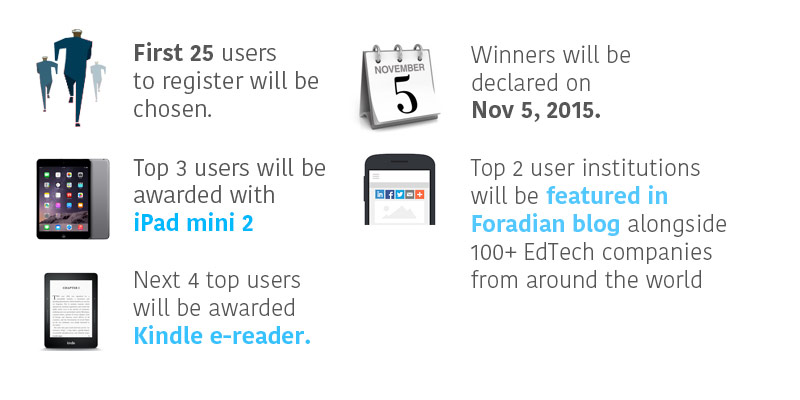
In our last post on the Top Fedena User program, we had published the list of top Fedena users as of end of August. Today, we are here with the result for the month of September.
 
As a part of our constant effort to help Fedena customers use technology in their institution to boost productivity, we launched the ‘Rewarding the Top Fedena User’ program. The program included all Fedena SaaS clients; but only those institutions who have agreed upon their participation through the invitation, have been included in the program.
 
Below is the list of Top 10 Fedena Users as of end of September, 2015:
 
Sept-2015
 
Stay tuned to know the winners in the first week of November!


Benefits of Education Softwares to Little Learners

benefits
 
Education softwares can work wonders for students of all ages; and especially for young children. How? Technology is giving a new meaning to education. Education softwares can help children get the best possible learning- with the presence of technology in every household, it’s not a mission impossible. Children as young as kindergarten goers are so fluent with iPads and other tools. So, why not make the most of this fluency with providing them educational software that’ll help to learn in the most comfortable way. Let’s delve further into how education softwares are going to do good to the little learners.
 
The benefits of using education softwares are as follows:
 
The primary benefit of using educational software in classroom is that it offers students, a wide variety of options for learning, solve academic problems, connect with classmates, have complete control of their experience.
 

  • Education softwares are more beneficial to students with disabilities. Particularly those who have visual, hearing and motor disabilities and they require own space and time to learn things.
  • Children, nowadays, spend much of their day’s time in front of the computer. They are fascinated with technologies and softwares. Their interest and involvement in education softwares can help them learn faster and effectively.
  • When students are encouraged to learn through educational software, they are actually motivated to gain confidence and improve self-esteem. They are sure of themselves to learn on their own without much help from parents or teachers.
  • When students are exposed to technology and education softwares at a very young age, they develop a good attitude towards it.

 
The benefits of education softwares might vary from student to student and also depends on the kind of educational software chosen. Technology and computer are here to stay. It’s on the parents and teachers to provide students with the right amount of exposure to educational software to optimize learning.
 

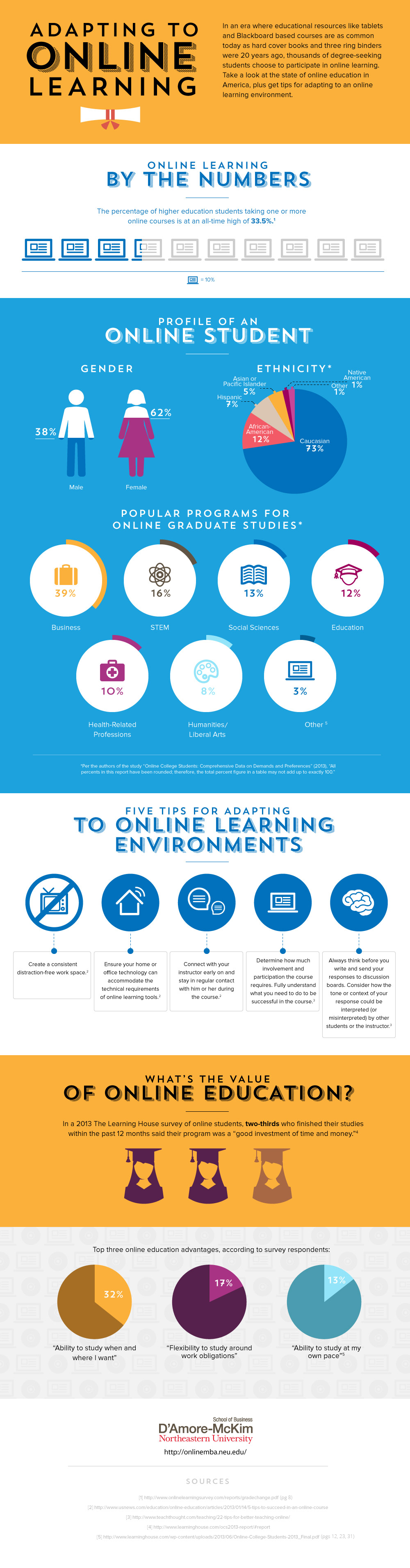
Infographic: Adapting to Online Learning

 
In an era where educational resources like tablets and Blackboard based courses are as common today as hard cover books and three ring binders were 20 years ago, thousands of degree-seeking students choose to participate in online learning. Take a look at the state of online education in America, plus get tips for adapting to an online learning environment.
 
Adapting_to_Online_Learning
 
The source: onlinebusiness.northeastern.edu
 
About the author:
 
Megan Barnes  is a freelance journalist and researcher that is passionate about education and technology. She is particularly fascinated by the way technology is reshaping the educational landscape and she enjoys sharing her research and ideas online.
 

Participate in Green Schools Programme and Take your First step towards a Greener Future

greenschool600x350 (2)

 
Centre for Science and Environment (CSE), the New Delhi-based public interest group, is conducting the Green Schools Programme (GSP). This programme has been running for past eight years and 2500+ schools across India have carried out a rigorous audit on environmental practices within their premises, following a set of guidelines outlined in CSE’s Green Schools Audit Manual.
 
GSP aims to kindle the spirit of environment conservation among school students. Our programme seeks to foster environmental literacy by moving beyond theories and textbooks and focus on “doing”. The programme helps schools to audit the use of natural resources, provides them the methodology to assess themselves as environmental managers and plug the identified gaps.
 
The audit allows the students to understand what is taught in the classroom better, with emphasis on teamwork and collaboration. For example, Measuring of garbage collected (Maths); Composting Methods (Biology); Narrative report (proficiency in English); Online submission (computer application); Waste Management Campaign (Civics/ Social Studies), etc.
 
The audit is open for registration and you can submit your report by Oct 31. Register at http://www.greenschoolsprogramme.org/registration/ and become a Green School*. Help us spread the green message through your students so they can be adequately prepared for the future they will inherit from us.
 
The collected reports will set benchmarks for environmental practices in schools which can be used by your school for further improvements. You can access the performance dashboard in March, which will enable you to compare your performance, year on year.
 
Following the GSP audit, a Delhi school introduced solar panels resulting in 12% decrease in electricity billing. Another school (in Chhattisgarh) increased the amount of waste water they reuse from 9000 litres to 22,240 litres. These are just a few examples from a long list of benefits that the participating schools got from GSP.
 
*A Green School is a resource-efficient building – one which uses less water, optimizes energy efficiency, generates less waste, catches and recycles water and provides healthier space for its occupants, as compared to a conventional building.
 

For any queries related to the programme, please contact Ranjita at ranjita@cseindia.org, or call at +91-9871825346


5 Cities for Higher Education in Canada

Cities-for-Higher-Education-in-Canada
 
Canada is often seen as a popular destination for higher education for its lower cost cost of living and education fees, particularly when compared to other countries like USA, Australia and U.K. In addition, it is one of those countries that stands out for its good quality of living; many a time voted as the ‘best place to live’ in the world and also has a reputation of offering great work culture! If you are looking forward to pack your bags and finish your studies in Canada, and somewhat confused as to which place will serve you best as a student; we bring to you five such cities for higher education in Canada to look out for! Read on.
 
Toronto East Gardiner Expressway and the City
 
Toronto: The largest city of Canada, Toronto is highly popular when it comes to cities for higher education for student around the globe. So what makes the city popular among students? Surely, the world ranked universities like the University of Toronto, Ryerson University, York University along with other institutions of higher education including Seneca College, Toronto Royal Conservatory of Music, George Brown College, etc. Toronto has always been a cultural hub, famous for entertainment, clubbing, restaurants and art.
 
Montreal
 
Montreal: Students favour the second largest city in Canada, Montreal as one of the most favorite cities for higher education for it offers them a vibrant student life with cinemas, shopping malls, bars, plenty of theatre and music, dance and visual arts, etc. More so, because of the top class universities like McGill University that is often counted in the list of top 50 universities in the world. There is also the famous Université de Montréal, Concordia University, LaSalle College, Vanier College, HEC Montréal, etc.
 
Vancouver (1)
 
Vancouver: As one of the popular cities for higher education in Canada, Vancouver has the famous University of British Columbia. Besides, there is Vancouver Island University, University of Victoria, Columbia College, Regent College, The Art Institute of Vancouver, etc. Moreover, the place offers amazing landscape, lot of cultural and other events; thus making it a popular place for tourists.
 
Quebec-City
 
Quebec City: Quebec City offers that beautiful picture of an old, historical place, founded in the 17th century. This heritage city also boasts an equally interesting liveliness  with cultural activities, music festivals, Winter Carnival and lot more. To make it more attractive as one of cities for higher education in Canada, there is  Université du Québec, Laval University, Morrin College, etc.
 
Edmonton
 
Edmonton: Edmonton is the capital city of Alberta in Canada. The numerous universities and places of education like the University of Alberta, MacEwan University, NorQuest College, King’s University College, etc makes it one of the popular cities for higher education in Canada. Besides, the additional attractions like the natural beauty all around the city, live-performances, downtown art exhibitions, the largest living history museum, etc add to the beauty of the place.
 

Benefits of Audiobooks in Education

Benefits-of-Audiobooks-in-Education
 
The benefits of audiobooks have been quite eminent to learners who have learning disabilities, for quite sometime now. On the other hand, audiobooks can actually be a smarter alternative to reading books- something that many people have started considering old-fashioned with the advent of technology. The surge in the past few years on the popularity of audiobooks played in iPods and other listening gadgets, itself stands witness to how the benefits of audiobooks are taking the joy of reading books to the next level.
 
So far, use of audiobooks in education have been concentrated to helping students with impairments or students who learn any second-language. But, it can actually be of much use to all students. Let’s see what are the benefits of audiobooks:
 

  • Many audiobooks come with a narration by the authors themselves. In that case, the mood or emotion attached to each phase of the story is best expressed by the writers themselves. Definitely, an additional help for students of literature to study moods and other nuances hiding in between lines.
  •  

  • Pronunciation is surely one of the benefits of audiobooks that can’t be ignored. Reading an audiobook brings out all possibilities of pronouncing words. Students looking forward to learning proper pronunciation of words can make the most of it.
  •  

  • Moreover, the convenience with which one can listen to an audiobook is noteworthy. Plugging in earphones, listening to a chapter and writing down notes simultaneously sounds so much easier than reading the text and write. Storing an audiobook is equally easy with all those mobile devices; using it is simpler; anytime, anywhere.
  •  

  • Various studies have been carried out in different points of time that have proved that students can grasp and remember a short story when they listen rather than the time they read it.

 
When we say benefits of audiobooks are more prominent than that of reading a textbook, it definitely depends on the kind of book or the subject that’s transformed into an audiobook. When the topic of reading is difficult, perhaps, reading the topic through pages is more welcoming as it allows the reader to refer to surrounding text for reference. Likewise, different students have different level of understanding a text. For some, an audiobook may be too fast to learn from; while others might not be comfortable using the audio devices and prefer the easy accessibility of books.
 
The cost factors plays a huge role in the lack of usage of audiobooks in education institutions. Most schools still run short of budget for these kind of purchases. Hence, the availability is still in the lower numbers in school libraries. Reading through books is better or listening to an audiobook? The question varies with each individual student and their learning capacity. Still, audiobooks has a lot to offer, if the possibilities of learning are explored well.

Rewarding the Top Fedena User’: Top 10 Fedena Users as of End of August 2015!

‘Rewarding-the-Top-Fedena-User’
 
We all know by now, how technology is changing the way education is imparted. In fact, not just classroom technology that has been revolutionised by education, management of institution too, is not lagging behind. Fading are those days when all administrative records were maintained in sheets by a personnel. Technology has come up with smarter and more effective ways to manage your education institution. And Fedena, for the last six years have been trying to revolutionise the way institutions are managed all over the world.
 
As a part of our effort to help Fedena customers to use technology in their institution to boost productivity, team Fedena had launched ‘Rewarding the Top Fedena User’ program. In this, we had invited all Fedena SaaS clients to be a part of it. The program received a good amount of response and institutions who have agreed upon their participation, have been included in the program.
 
First25 (1)
 
Find below the list of top 10 Fedena users at the end of August 2015:
 
August-2015
 
We will be coming out with the list of Top 10 Fedena users again at the end of September. Stay tuned to check out who tops the list!
 

Things to do for a Productive Student Life in College

 
Things-to-do-for-a-Productive-Student-Life-in-College
 
College is the time when every student should look forward to curve out a better future. Apart from studying, the student life in college can be made more productive with a lot of other activities – things that can help you enhance your skills and add some experience for the job life that awaits you post college. These are some of the few things that can be productive for your student life:
 
Travel or Study Abroad: To make the most of your college student life, you can opt for studying abroad. In that way, you have a good chance to broaden your perspective and finish your studies as well. Choosing a university overseas might add those extra costs to your wallet, but it’s surely going to be one new experience of student life that you must have. If not for the entire course, you can still opt for field trips or get your tuition transferred to a school in another city, linked with your university.
 
Opt for an internship: Internships give you a real work experience. A student life in college is incomplete if you don’t gain real-work experience in your field of study. Hence, opting for an internship is a smart idea to increase your employability chances after college. Internship can be a full-time or part-time or even a work-from-home experience; choose the one that’ll give you maximum exposure to the job you are aiming for.
 
Explore research opportunities: Research opportunities bring you ways to make the most of your student life and college education. Join a research program that requires you to do surveys and interviews. In short, grab the opportunity to do get experiences in works like data collection, analysis, report generation, etc.
 
Learn a language: Other than your subject of study at college, make your student life at college more exciting and learn new things- a new language preferably. You never know when learning a foreign language can be of great help to you post graduation. Many companies look out for graduates who are fluent in more than one international language, a language other than English maybe.
 
Enjoy student fests and network! College is the time when you can actually do a lot of networking, meet and connect with new people with similar passion and interest as yours. Student life at college is less exciting if you don’t attend college fests, club meets, group activities which can also serve as the meeting spots for networking.
 
Getting a real idea about how your goals are shaping up is always an added advantage. And college is the best time where you can add those effort towards your goal.