Is Online Learning platform Catchy Enough to Replace the Classroom?

Schedule--transport-&-hostel (1)

In an era where most toddlers are comfortable with a smartphone as with crayon, it would be foolish to think that the traditional model of education will survive as is. Innovation demands constant change, most of which is evident in the methodologies of higher education.

To cut to the quick, online learning platform has become quite popular with the masses. Therefore with Uzity learning management system, the teaching and learning is become easy and convenient. Using Uzity, instructor can easily deliver material to the students, administer tests and other assignments, track student progress, and manage record-keeping. So get ready to build your own alliance to deliver the amazing learning experience. However, the debatable question here is – How much disruption from the classroom-model can we expect from online education? Delving into the details later, it can be simply put that traditional methods of teaching are on the cusp of a dramatic transformation.


The Benefits as We Know it

Online platforms, especially social media websites, have empowered us to replace many customarily interactive processes like dating, shopping, and banking. Getting educated online is probably the next frontier for internet-based expediency. Here is why:

  • You can afford it: Online learning requires no cost to self. More than 300 hours of lectures from Harvard, Berkeley, and MIT are available on Youtube. This medium of imparting education is more scalable due to its reduced overhead costs as opposed to the brick-and-mortar schools.
  • It is convenient: You can take an online course any time of the day, at your own convenience. Most of the distance learning programs have online communities and forums that increase accessibility and usability.
  • You know where to find it: The courses are available online; so all you need to have is a good internet connection. MOOCs (massive open online courses) are readily accessible to a diverse blend of student backgrounds, experiences, geographies, and motivations.
  • Controlled learning: With online learning you have more flexibility to choose the where, what, when, how, and how much of education that you acquire. Students could choose EdX MOOCs for a variety of different reasons. Some are simply hoping to learn, some are looking for knowledge to aid in some other classes that they are taking, while others are probably teachers looking to gain some quality insights about the latest in the field of teaching.
  • Prepare for the future: In terms of employment, recruiters today prefer candidates who are well-versed with the detailed nuances of dynamic learning. Since online learning is implemented as a training tool in organizations, it’s best that you sample its worth for a clear path ahead.

Innovation Vs Tradition

Just like some people can never get over the feel of a hard-bound book, many learners continue to prefer the face-to-face, teacher-led interaction of the traditional classroom setting. Although, loyalty and adherence to age-old practices could retain a certain fragment of the student population, a failure in integrating technology and education could prove detrimental to an educational institution’s sustainability.

As we all know, schools have always been the centers of tradition and innovation. Although teachers are likely to blend the practices of both online and in-person learning, ultimately it’s up to the innovators and the preferences of the learners to obtain knowledge from any medium of choice.

Competition in the online learning space is fierce, with innovators encouraging trials and errors to transform the educational process. Here are some trends that could possibly tip the balance in near future:

  • Wearable gadgets: This includes devices like google glass, smart watch, etc. which is knowledge in your pocket – on the go.
  • BYOD: Exciting as it sounds; BYOD refers to bring your own device. Through this concept, students are permitted to bring their laptops, tablets, etc. in a classroom for the sake of taking notes.
  • Sharing Portals: Cloud and social media websites have become common platforms for sharing assignments and other study material. Be it Dropbox, Google drive, or iCloud, sharing massive files is just one click away.
  • Blended & Flipped learning: Flipped learning is getting information through an instructional video and then displaying a rendition of your learning through project work. Blended learning on the other hand is a combination of online and classroom teaching.
  • Last but not the least, this era is all about the apps! There is an app for learning anything and everything. Be it science or literature, a simple download can go miles in teaching you something constructive in life.

In the end…

While there is improvement and students have begun to adopt online learning on a large scale, education providers still need time to conclude whether students will drift towards the classrooms that keep them in line, or the classrooms that keep them online. Rest assured, this wave of online learning is sure to take the world by storm.

Happy learning!


The article is written by:


Tina Jindal. She is a professional writer who works on a variety of topics like employment, real estate, and education. A staunch supporter of online learning and education, career advisor for naukri.com, she has been involved with renowned publications as well.

Managing hostel and transport fee collections made easy

Schedule--transport-&-hostel


Many of you might recall that when a hostel or transport fee collection was scheduled for a batch, there was no way to assign the same fee collection to a newly admitted student. You would have to schedule a fee collection for the batch of students all over again. We soon realised this can be pretty inconvenient and sometimes frustrating since students leave and join schools and colleges all through the year. So to make things easier for you, with Fedena 3.4, we are providing you the ability to manage hostel and transport fee collections at an individual student level. You can now assign existing fee collections to a newly admitted student or schedule new fee collections for a particular student.

Who can schedule fee collections

Administrators and privileged employees (Hostel Admin or Transport Admin privilege must be provided) can schedule hostel and transport fee collections.

Prerequisites to scheduling fee collections

Hostel and transport fee collections can be scheduled only for students who have been provided hostel and transport facilities. So make sure to allot hostel and transport facilities to all students who require it, and then schedule fee collections.

Schedule a hostel fee collection for a student

As mentioned earlier, you can assign an existing hostel fee collection or schedule a new fee collection for a student.


Assign an existing hostel fee collection to a student


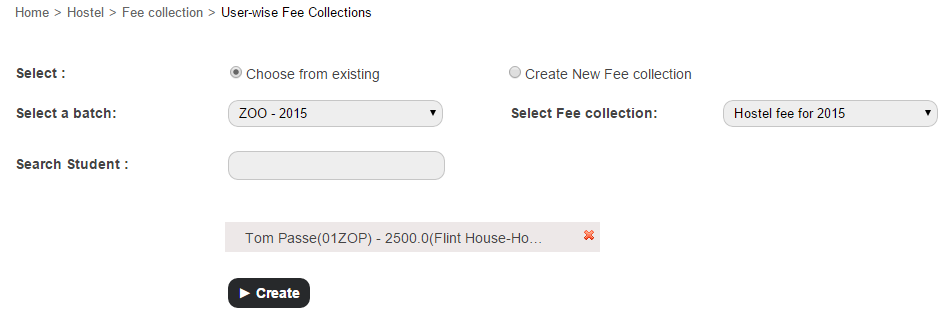
  1. At the top of your dashboard, click the module access icon > Administration > Hostel Fee Collection > User-wise Fee Collections to open the User-wise Fee Collections page.Managing hostel and transport fee collections made easy2
  2. Select the Choose from existing option
  3. Select a batch and a fee collection.
  4. In the Search Student field, enter the name or admission number of the student to search and assign.
  5. Click the Create button.

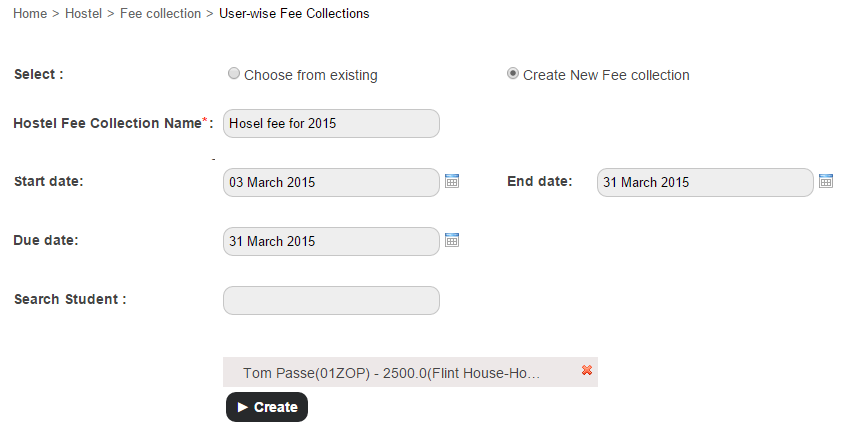
Schedule a new hostel fee collection for a student


  1. At the top of your dashboard, click the module access icon > Administration > Hostel > Fee Collection > User-wise Fee Collections to open the User-wise Fee Collections page.Managing hostel and transport fee collections made easy3
  2. Select the Create New Fee Collection option.
  3. Enter the name of the hostel fee collection.
  4. In the Start date and End date fields, select the starting and end date within which the student must pay the hostel fee.
  5. In the Due date field, select the last date within which the student must pay the hostel fee. Students who do not pay the fee on or before the due date will be listed as a fee defaulter.
  6. In the Search Student field, enter the name or admission number of the student to search and assign.
  7. Click the Create button.

Schedule a transport fee collection for a student

Similar to hostel, you can assign an existing transport fee collection or schedule a new fee collection for a student.
Assign an existing transport fee collection to a student


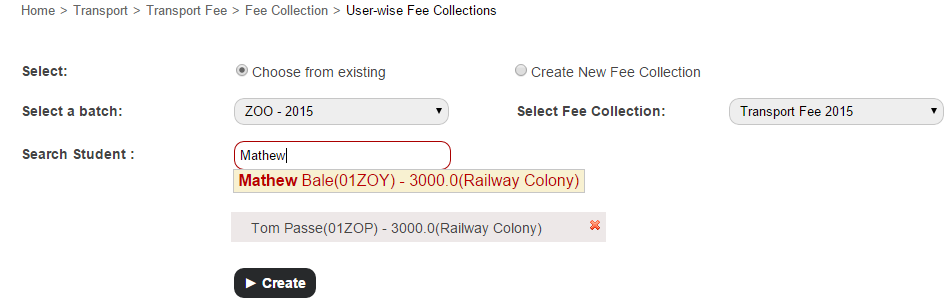
  1. At the top of your dashboard, click the module access icon > Administration > Transport > Transport Fee > Fee Collections > User-wise Fee Collections to open the User wise Fee Collections page.
    Managing hostel and transport fee collections made easy
  2. Select the Choose from existing option.
  3. Select a batch and a fee collection.
  4. In the Search Student field, enter the name or admission number of the student to search and assign.
  5. Click the Create button.

Schedule a new transport fee collection for a student


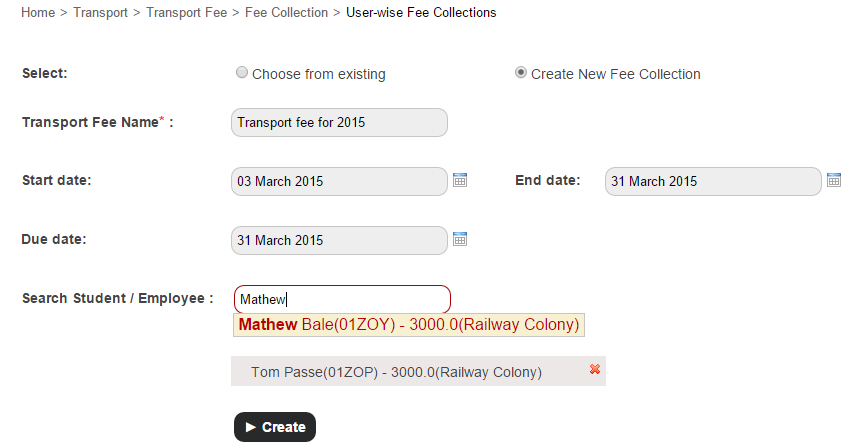
  1. At the top of your dashboard, click the module access icon > Administration > Transport Transport Fee > Fee Collections > User-wise Fee Collections to open the User-wise Fee Collections page.
    Managing hostel and transport fee collections made easy1
  2. Select the Create New Fee Collection option.
  3. Enter the name of the transport fee collection.
  4. In the Start date and End date fields, select the start and end date within which the student must pay the transport fee.
  5. In the Due date field, select the final date within which the student must pay the transport fee. Students who do not pay the fee on or before the due date will be listed as a fee defaulter.
  6. In the Search Student/Employee field, enter the name or admission number of the student to search and assign.
  7. Click the Create button.

Something to note is that transport fees not only applies to students, but to employees as well. So you can now also schedule transport fee collections for individual employees.

The Evolution of Classroom Technology: The Journey from Pen to Keyboard

Education and technology has always been in perfect harmony. Right from the days when chalkboards were invented during the 18th century till the interactive whiteboards started revolutionizing classroom learning, education has gone hand-in-hand with technology. Below find a very interesting infographic, tracking the evolution of technology in classrooms; for it’s not just important to know where the future is heading to in education, the past also matters!

Ancient technology in classroom

Horn Book

1650

Horn Books, wooden paddles with printed lesson was popular during the colonial era, to help students learn verses.

Magic Lantern

1870

Magic Lantern, the predecessor to slide machines, projected images printed on glass plates in 1870. Public school systems in Chicago started using more than 8000 lanterns by 1915.

Slate

1890

Chalkboards and school slates came into use by 1890 followed by pencils in 1900. Wide availability of pencil and paper made school slates obsolete.

Radio

1920

A new form of learning evolved with radio on-air classes for students within listening range in the 1920s. Board of Education, New York City broadcasted lessons to schools via a radio station.

Projector

1930

1930 and 1940 saw the introduction of overhead projector and ballpoint pen in classroom education.

Scantron

1972

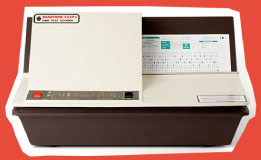
In 1972 came the Scantron system of testing which allowed teachers and educators to grade exams more effectively and efficiently.

The age of personal computers

computer

1981

Computers came to daily use in the 80’s with the first portable computer was introduced in 1981. During 1984, public schools in U.S had one computer in average for every 92 students.

calculator

1985

Hand held graphing calculators were introduced in 1985 and it became a great sensation in the field of maths. Year 1985 also saw the CD-ROM Drive coming to use. A single disc could store a whole lot of things like an entire encyclopedia along with video and audio.

w3

1996

The internet, which was by then considered a computer network used mostly by NASA physicists and academics, slowly entered into homes and educational institutions by 1996.

white-board

1999

Technology in the classroom reached new heights with interactive whiteboards which blended handwritten notes with interactive technology in 1999. Earlier versions of these whiteboards were connected to desktop computers through wires, whilst the latest ones are compatible with smartphones and tablets.

tablet

2007

2007-2010 was the age for smartphones and tablets. The concept of classroom slates got a revamp with iPads which is taking classroom education to new heights.

Classroom technology in the future

Biometrics

Biometrics, the science that recognizes people on behavioral or physical qualities, is surely the answer to student disposition in the classroom and develop teaching materials accordingly.

wearable-glass

Wearable devices in education is the next big thing to watch out. Virtual reality headgears, wristbands, smart watches will take education to the next level.

multi-touch

Multi-touch surfaces like desks or workstations can work wonder for students to collaborate with their peers around the world. Videos, online resources and other virtual tools available in the single swipe of the desk.

Share this Infographic on your site

Kicking off 2015 with Fedena 3.4.1

Design-Blog


2014 has been a great year for Fedena. We’ve grown massively as a company and as a product. So to continue the momentum, we are thrilled to kick off 2015 on a high note with our latest release – Fedena 3.4.1. With our latest release, we’re introducing, roll numbers for students, a single view for all your batch information, greater control over student fee collections and timetables, and more.

Student Roll Number

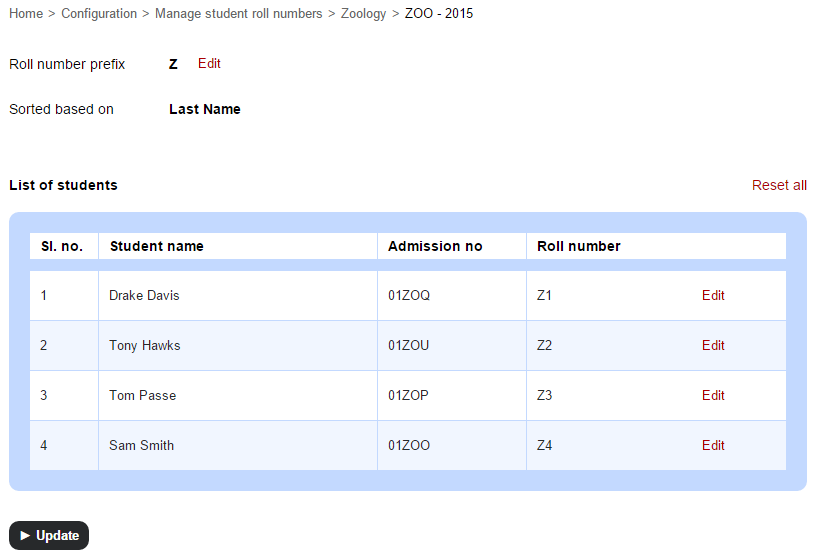
The feature many of you have been waiting for. Assign roll numbers to students that conform to your institution’s numbering scheme.

Student Roll Numbers

Consistent Date and Time Format

Pick the date format you want displayed consistently throughout Fedena. Time is now consistently displayed in 12 hour format.

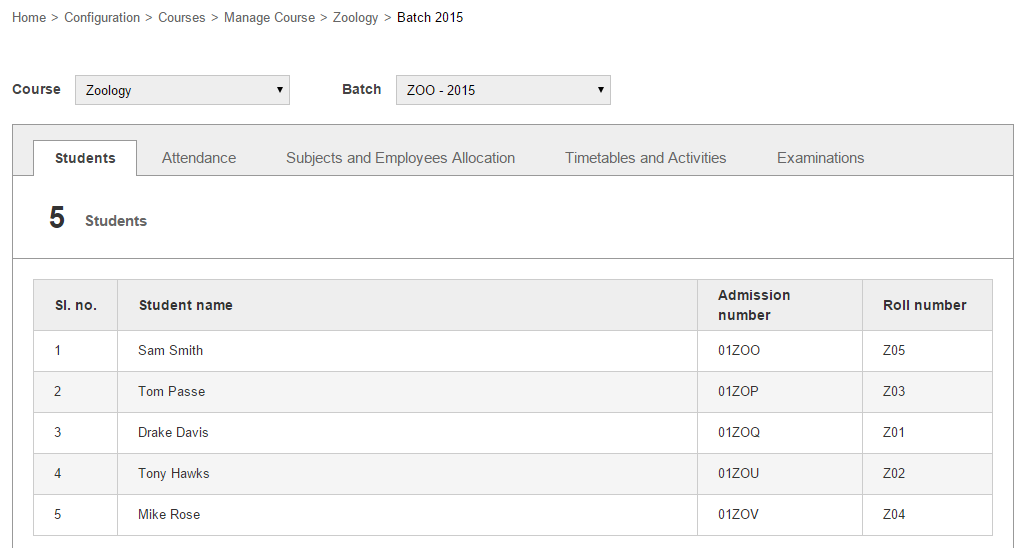
Batch Summary

Keeping track of all your batch activities has never been this easy and convenient. Tutors can now view all information about the batches they handle from a single view.

Batch summary

Institution Type Setting

Specify if your institution is a K-12 or Higher Education type of institution and see subtle changes in your Fedena interface.

Student Fee Collections

Several enhancements have been made to scheduling and managing student fee collection to provide further flexibility and speed up your fee collection process. To highlight a few enhancements:

  • Ability to create discounts on fee categories as well as on fee particulars
  • Ability to create instant fee particulars or instant fee discounts when collecting fees

Timetable

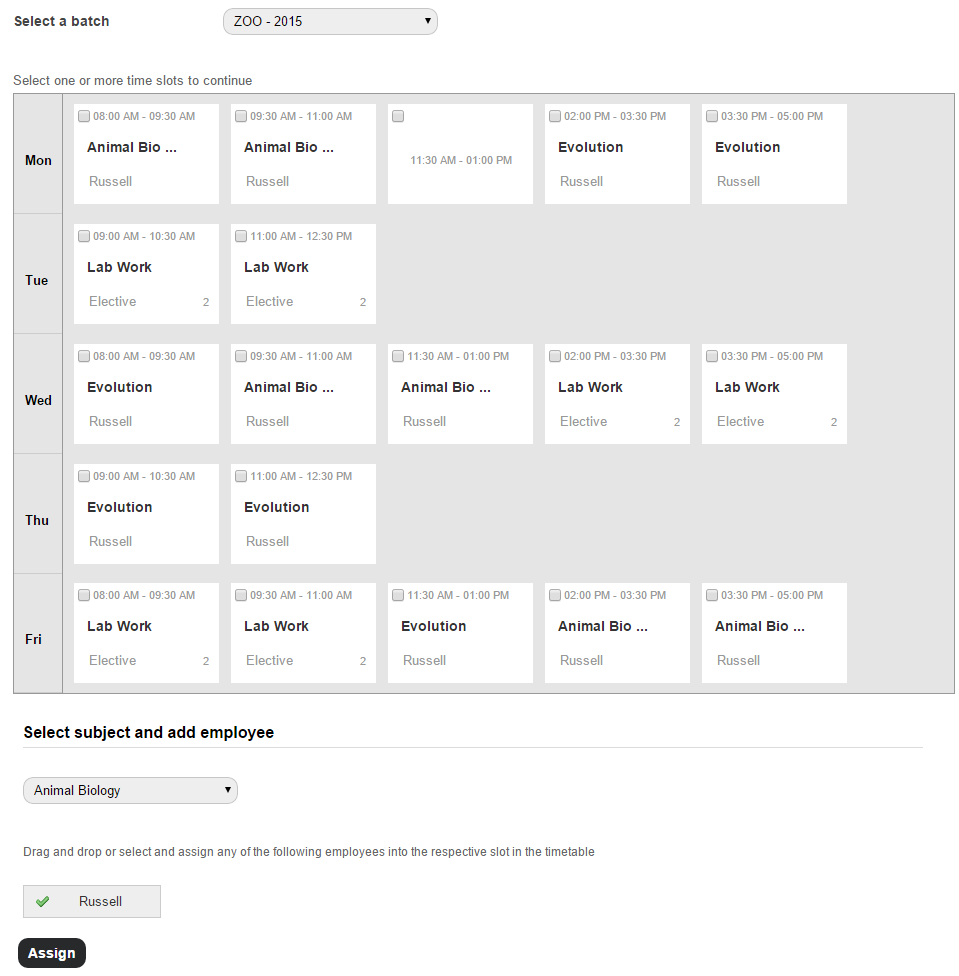
A fresh interface that offers greater control to help you create those timetables you’ve always wanted to for your institution. Some of the enhancements include:

  • Ability to assign different class timing sets to each weekday
  • An enhanced user interface that makes it easy to assign employees to class timing records when creating timetables. Timetable
  • In a printed timetable, breaks are indicated as a broad grey line between periods.

We hope you enjoy this release, and as always, we love to hear from you. Write to us at info@fedena.com and give us feedback on what would make your Fedena experience even better.

Adding Custom Fields to Record Transport and Hostel Information

Custom--transport-&-hostel2
The latest version of Fedena has many new features as well as enhancements that extend its flexibility and benefits. One of the features added is the ability to add custom fields to record any information about your institution’s transport and hostels.


So the next time you use the Transport plugin to record vehicle and vehicle route information, or the Hostel plugin to record hostel and hostel room information, just remember, you can add custom fields to record any additional information deemed required or important to your institution.

Who can add custom fields?

Administrators and privileged employees (Transport Admin or Hostel Admin privilege must be provided) can add custom fields.

How to add custom fields?

Transport

  1. Go to the Transport module (Module access icon > Administration > Transport).
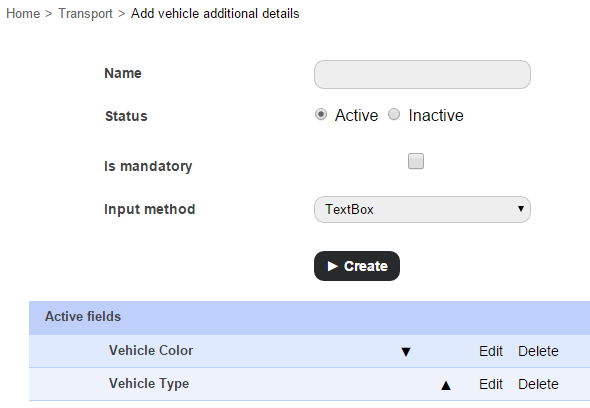
  2. Click Manage vehicle additional details to add custom fields to record additional information about your institution’s vehicles, or click Manage route additional details to add custom fields to record additional information about your vehicle routes.
    1 (2)
  3. Enter the name of the custom field.
  4. Select the status of the custom field from the following options:
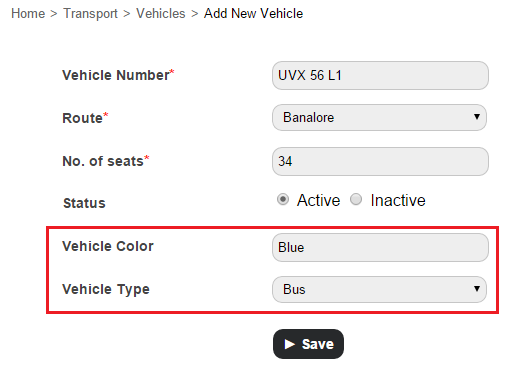
    • Active – A custom field with this status will be available when recording vehicle or route information. For example, in the image below, the highlighted fields were custom added fields.
      2 (2)
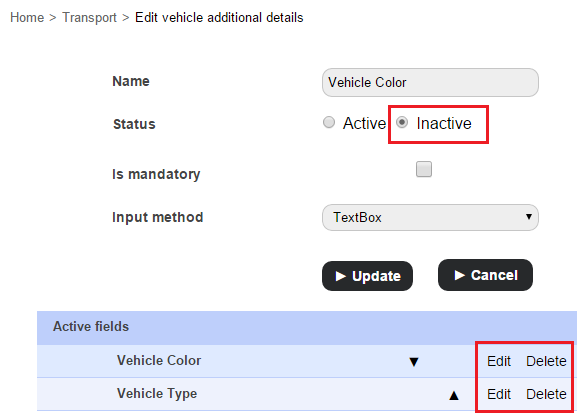
    • Inactive – A custom field with this status will not be available when recording vehicle or route information.
  5. Select the Is mandatory checkbox to set this field as a mandatory field that must be filled.
  6. In the Input method field, select the field input method from the following options:
    • Text Box – Enter brief text information.
    • Text Area – Enter detailed text information.
    • Select Box – Select an option from a drop-down list.
    • Check Box – Select one or more items from a set of options.
  7. Click the Create button.
  8. Use the arrow icons ( 3 ) to determine the order the fields will appear in when recording vehicle or route information.
 

Hostel

  1. Go to the Hostel module (Module access icon > Administration > Hostel).
  2. Click Manage hostel additional details to add custom fields to record additional information about your institution’s hostels, or click Manage room additional details to add custom fields to record additional information about your hostel rooms.
  3. The rest of the procedure is the same as for Transport.

Custom additional fields can be made inactive at any time by editing and selecting the Inactive radio button. Once a custom field is made inactive, it will no longer be available when recording transport or hostel information.

4

Custom fields can also be deleted, but only if it has not already been used to record transport or hostel information.

Making Fedena Website Mobile-friendly: The Story Behind

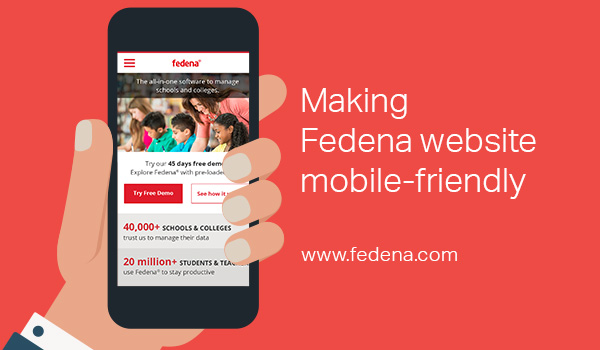
Fedena-Mobile
With the role mobile phones play in our lives today, there isn’t a single doubt about the role handheld devices (especially mobile phones) play in taking forward businesses. Reach of business/product is greatly influenced by the number of mobile phone users covered. Not only that, Google has made it clear that websites that do well on mobile will get a solid boost in search ranking as well.

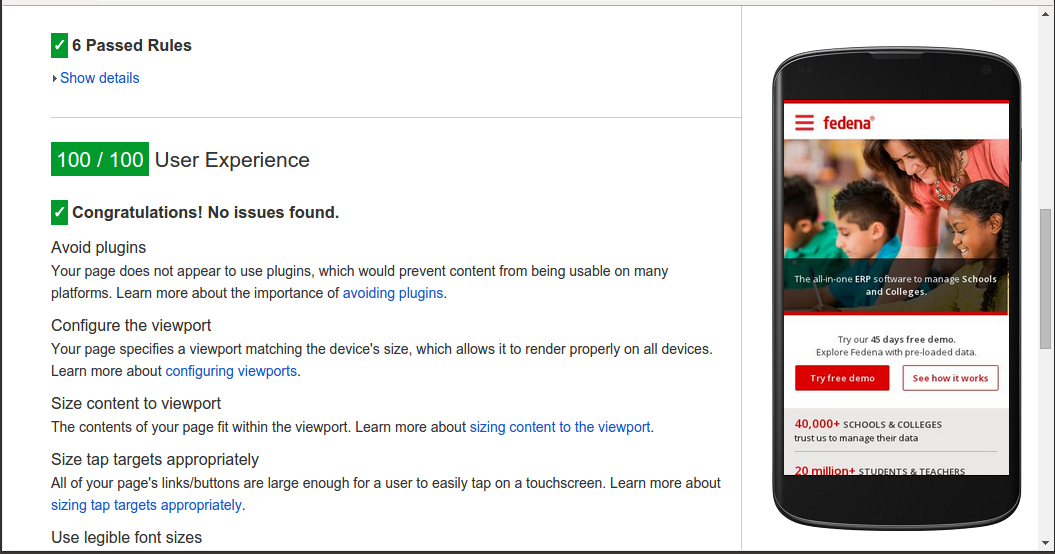
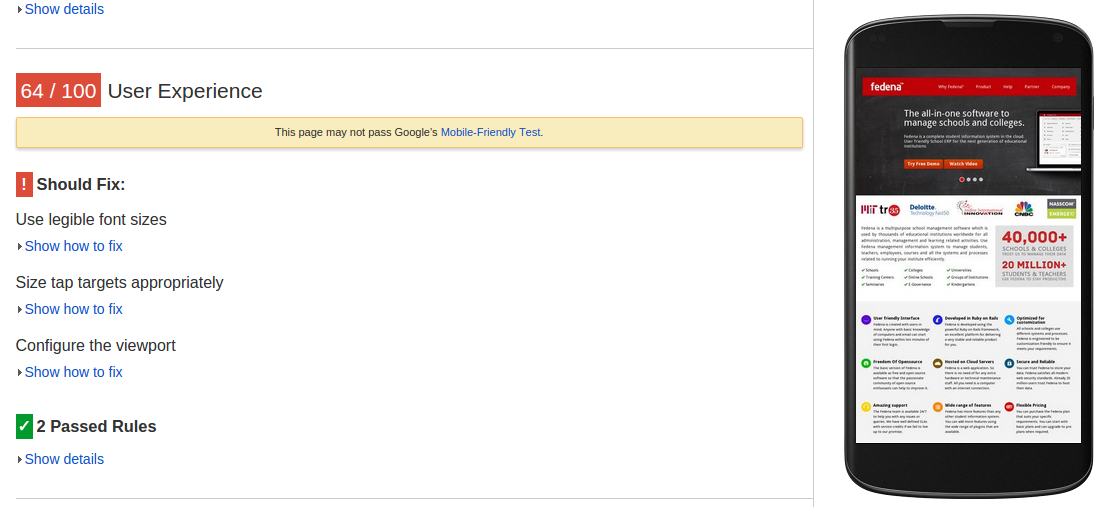
1

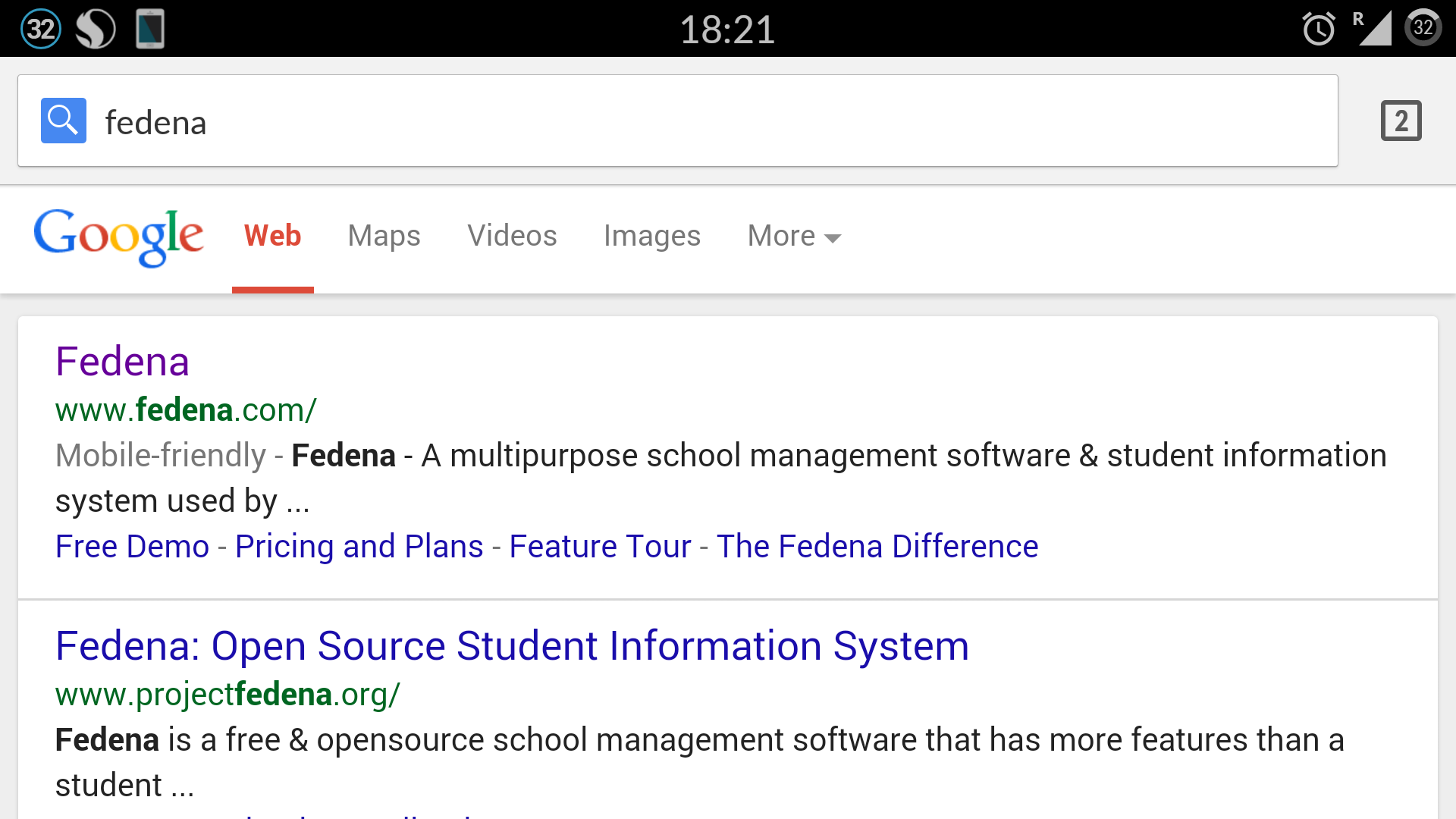
The above image shows the user experience our page (www.fedena.com) provided with respect to mobile users. It clearly depicts that the site is not mobile-friendly. Mobile friendly websites have gained so much importance and popularity that Forbes has included it in their marketing checklist. Delivering audience the content they want, within the context they are viewing it, is the one thing any business should take care of.

Let’s get Started

We wanted to build a mobile-friendly version of our site and there were two approaches to choose from:

  1. Modify the existing version
  2. Build new one from the scratch

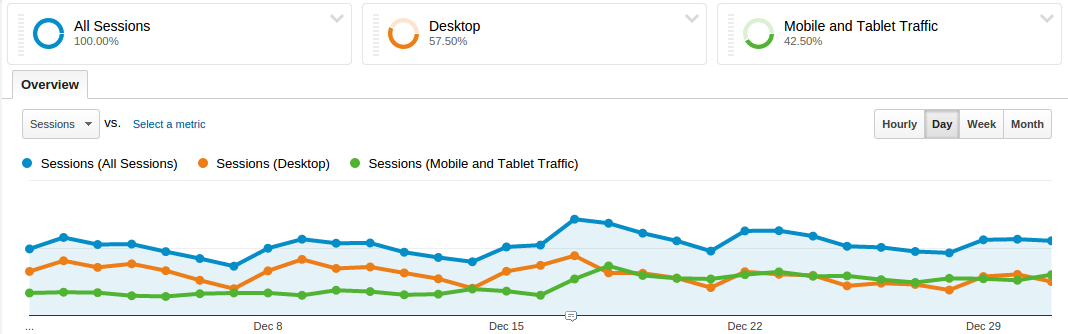
The second approach make things simpler as all you need are a design, an approach and a mechanism of handling various devices, screens and resolutions. At Foradian, our Fedena website was already functional and much in use. So we had to think of the ways to reach out to the entire range of customer base and also we wanted to do it ASAP. The below image shows the distribution of our visitors on different devices:
2

Approaches

For search engines to understand that our website is set up for mobile too, we had to follow one among the three designs that Google has put forward for all the developers:

  1. Responsive Web Design
  2. Dynamic Serving
  3. Separate URLs

Having separate URLs seemed easier to implement as all we had to do was rewrite the contents and provide the views. Once the user tries to open a page through mobile, he/she will be redirected to the mobile version of the site i.e., m.fedena.com just like Yahoo! did earlier. This approach has other constraints like maintaining two versions of the site, being sure that all pages are provided with different views and that a page will have two URLs. Also Bing and Google advocate a one-URL approach for find-ability and SEO. So we thought of going with the other two designs and implementing them.

Our Approach

Dynamic Serving is a setup where the server responds with different HTML (and CSS) on the same URL depending on the User Agent requesting the page. User Agent is the string the browser sends to the server hosting the site which indicates the details of operating system being used, its version, the browser through which the site is being visited and its version so that the server can tailor the site according to the browser. Responsive web design (RWD) is a setup where the server always sends the same HTML code to all devices and CSS is used to alter the rendering of the page on the device. Simply put, Responsive design is a single version that auto-adjusts to display properly on all devices except the oldest cellphones or feature-phones.


However, the first two approaches have an advantage over the Separate URL approach – we need not have to have two separate URLs for the different versions. Also, we need not have to write separate views for each and every page; only the pages that are most important or viewed by many need to be handled.


How about implementing them both? Yes, we implemented both of these setups. Here’s how – depending on the User Agent, we planned to display a different layout. All handheld devices and desktop versions would have a different layout. But if that’s the case, how would we display content according to the screen sizes of handheld devices! That could be done through responsive design. So, it came down to two different layouts depending on User Agent and using media queries for each screen size or a screen size till a limit. Media Queries help in writing different styles for same classes and using them according to the media type and size.

Designing Priorities

At this stage, once the approach has been decided, we needed a design that is simple yet informative. Our aim in designing was to let the users have all the information they need and in the context they like but without sacrificing our content. For all mobile version of sites the top requirements are – a good design that would help users get the basic information he/she needs and the navigation links for every other page, keeping menus short and sweet, putting contact information up and front, providing links and adding videos and other features to keep the user engaged are sure ways to future-proof the site. Even the forms are simplified so that there will be no inconvenience to the user at any point. We have also decided to remind them as to which plan they are interested before filling the form which brings more clarity in them. Our design team did a splendid job and provided us the simplest UI with all the elements.

3

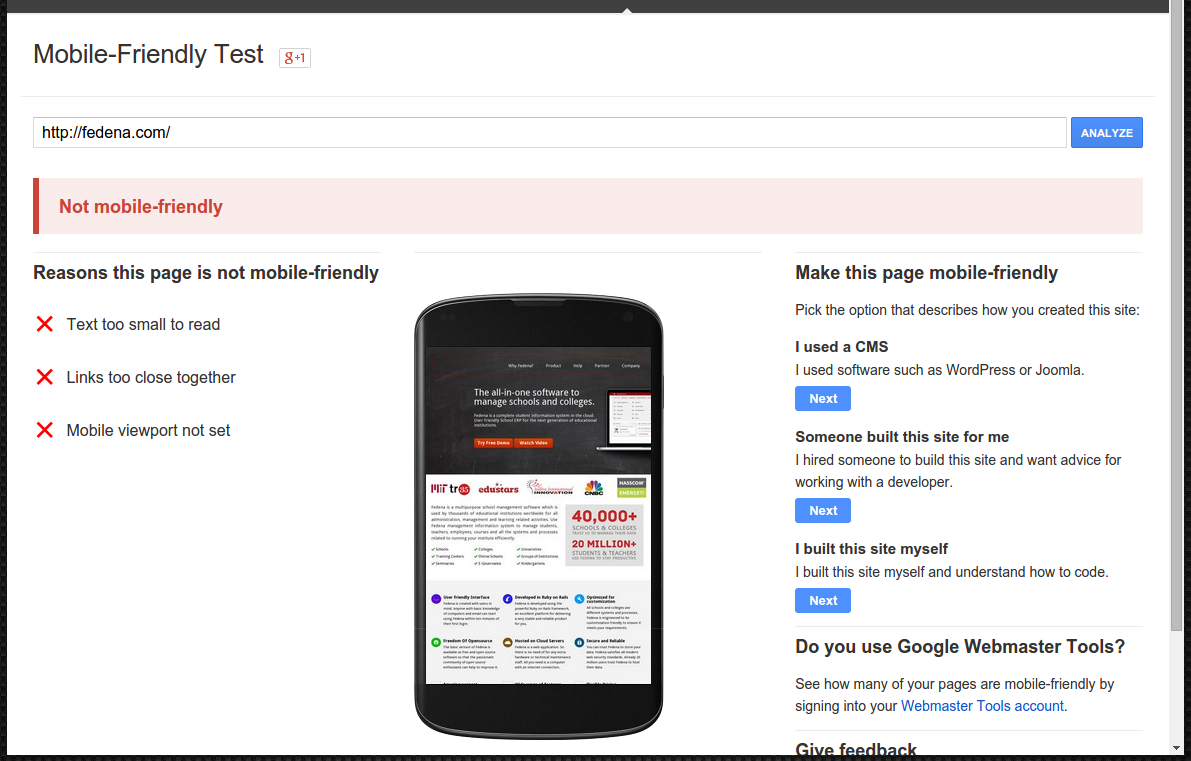
The above screenshot has been taken after Fedena website is made mobile-friendly.

Why a Framework

After getting the design, the first thing that we needed to decide upon was whether to use a framework and which one to use in that case. Challenge was to develop a modular structure that enables the content to best fit any screen size. To write the entire responsive CSS from scratch and making sure it works well in all browsers is a tedious task. That is where these frameworks enter and make life much easier.

Choosing a Framework

Among all the frameworks, Pure by Yahoo! caught our attention as it stands true to how it is described, as “an ultra light-weight and responsive set of CSS modules that can be employed in web projects at ease and they are responsive too !!.” Even though there were many other equally good frameworks along with Pure, its minimal and flat design which ensures that it would stand out of the way if needed was the foremost reason we chose Pure.
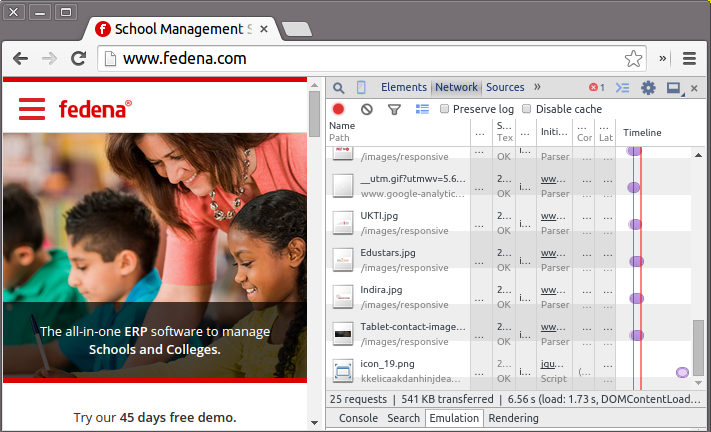
4 The above screenshot shows the size of the loaded page (541 KB) which is much smaller than the size of the desktop version. The page load size when viewed on a mobile internet device compared to being viewed on a desktop browser is comparatively smaller as the entire framework minified and Gzipped is only 19KB .

Development of the mobile version with design and frameworks and more

Featuring a video, content hiders, menu links as simple as they seem, implementing all these  might be a little difficult if we choose to ignore all the resources and plugins present. However, with the thousands of jQuery plugins and scripts present to assist in implementation, the developer just needs to choose the one that suits his/her requirement. In our case, we were happy with what jQueryUI accordion was providing and it took lesser time than writing it from scratch. We choose Owl Carousel, a touch enabled jQuery plugin that allowed us to create the beautiful responsive sliders. Apart from that the optimal use of jQuery/Javascript functionality made the implementation part much easy.

5

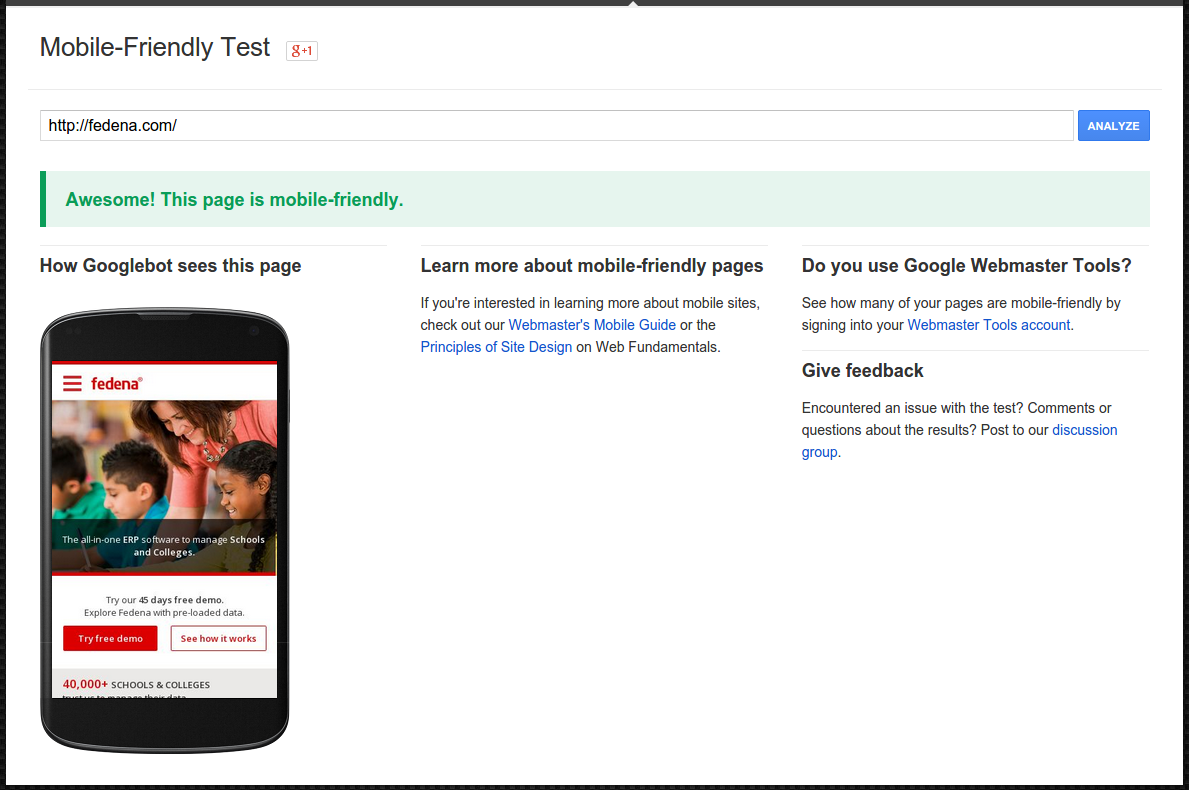
Now for a quick comparison, the below screenshot was taken before we started working on our website to make it mobile friendly.


6

Our Fedena website is now a mobile-friendly site. For a company that encourages its team to think like a customer, we are happy that our customers are now able to connect with us through their mobiles without any difficulty. More and more users are now accessing our site from their devices without any inconvenience. We are able to reach out to a wider user base, thanks to our mobile-friendly website.


7

As you can see in the above screenshot, we were successful in making fedena.com, a mobile-friendly site.
This article is written by:


IMG_2811 (1)  Poornima G


A developer by profession and an explorer by nature, she tends to learn new things from every avenue she traverses and finds happiness in implementing them in her endeavors.
Beyond the work-space, she intends to lose herself in sleeping, travelling and reading.

How can you look Forward to a Better GPA

GPA
Clearing all exams with just a passing mark is not enough. One should look forward to a good GPA (Grade Point Average) and make others envy about it. Do not be a kind of student who ignores when his GPA is being asked by other people; instead work hard and make efforts to secure a upright GPA as this will add spark in your resume and achievements.


There a few things which you should look forward for scoring a better and respectable GPA.


Don’t skip classes:


Plan your friends’ hangout and other plans after the class. Don’t skip your classes as this will make you miss your lessons and you will be unable to write down your notes. Also, this will limit your absences and you will not be able to skip the class in case of any emergency. Exceeding the limit will down-level your GPA.


Sleep well and eat well:


Your body and mind need to be good to work and for that you need proper sleep and appropriate meals. Don’t neglect your body by overloading it with junk food. Try to take home-made food to college. Follow a proper sleep routine. Watching movies late night in week days and eating a burger every day is a big no-no.


Write down your notes:


Yes, I know taking notes through camera or writing them on phone or laptop looks cool but it is not practical. Make sure you write down your notes with hands for an easy revision as notes on screen may stress your eyes and brain.


Balance your social and academic life:


Do not be a nerdy or such a book worm that your friends or family are hesitant to meet you. Take breaks often and hangout with people you love. We all know that all work and no play make jack a dull boy. Balance your social life and studies as it won’t harm your GPA; instead you will do good if your mind is refreshed.


Author Bio


Stewart works as a writer for one of the best UK dissertation writing service on internet. Dissertation Globe helps students who are looking for services to write dissertation and do my dissertation for me.

How to Revert an Archived Student

Revert-Archived
In our previous article, we showed you how to archive a student record. We also told you that when a student record is archived, the record moves from the active record list to the former record list. The record is not deleted from Fedena, so you can always find it later using the Advanced Search function. But there are times when you may need to revert an archived student record and make it active because:

  • you graduated a student in Fedena who was not eligible for graduation.
  • you accidentally archived the wrong student.
  • you are admitting a former student to your institution.

Whatever the reasons maybe, you can revert a student record as long as you’ve archived it and not deleted it.

Who can revert an archived student?

Administrators and privileged employees (Manage users, Admission, or Students control privilege must be provided) can revert an archived student.

Procedure

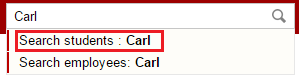
  1. Use Action Search at the top of your dashboard to search for an archived student. Search using the student’s first name, last name, or student admission number. When searching for a student, make sure to click Search students.
    1
  2. Click on the student name. The student’s profile is displayed.Revert an archived or graduated student
  3. In the top right, click the Revert archived student button.
  4. Click OK to confirm.

Does all records and settings get restored?

When an archived student is reverted, all records and settings including the student’s login credentials and batch information are restored except the following:

  • Any placement details that the student was part of
  • Online exam marks entered for the student
  • Hostel room allotment details
  • Transport route allotment details

Can Technological Reforms in Education Improve our Job Prospects?

Job-Prospects
“If we teach today as we taught yesterday, we rob our children of tomorrow.”
– John Dewey

We use technology in every domain of our lives. Be it education or household chores, without our prized gadgets we feel incomplete. However, have you ever wondered whether this technology is actually improving our work or have we just become super habituated to this trend so as to ignore the direction of its impact? For example, is technology really improving the quality of education in the world or is it just a fad that every individual is running after?

The Answer…

Initially, education technology was a simple debatable topic in the society. It soon grew into a massive idea with Steve Jobs entering the fray and proclaiming his vision for education. All he wanted to achieve was to revolutionize teaching and learning, which he did, leaving behind a legacy of numerous technological and educational apps.

To elucidate more on the topic of this article, there is no doubt that technology has improved the quality and standard of education in the world, but has it done so for the betterment of our future? Can you expect to land a great job because of the learning achieved through superior methods of teaching? The answer is, yes. Technology allows students to construct their own knowledge base, which can be employed to enhance business practices at work. It is but the bridge that connects education and employment. Here is a glimpse of the greatness that education technology has brought to the domain of employment:

  • Sparking Innovation

    Innovation has the tendency of killing jobs in order to construct some new ones. The society is progressing and its inhabitants are becoming richer by the moment, demanding more goods and services. 100 years ago, a majority of individuals across the globe were involved with farming. Now, a very less percentage of that number work in fields, but produce much more amounts of food. The millions freed from the land have not become jobless, but have found better-paying work with the evolution in economic and educational reforms.Needless to say, this universal change in tactics has its roots in educational restructurings. Exposure to technology at a young level has made individuals more aware of their surroundings and mental capabilities. Students can channel and package their creative genius in ways that were unknown in the past. Technology can give you wings. More so to the younger generation who can use this reform to spark innovation and think outside the box. A highly ingenious mind is always attractive to an employer, thereby improving employment opportunities.

  • Stimulating the grey matter

    The best answer to the topic of this discussion – reforms in education can improve your job prospects because of how they stimulate and excite the grey matter. Apart from improving your analytical and problem solving skills, exposure to all that information in a short period of time improves relationships and has the ability to bridge cultural gaps.A student well-versed with the latest trends can approach an employer with greater confidence and a positive attitude. Such an individual has the correct knowledge base required for the smooth functioning of an organization. Maturing at a young age through the magic of education helps in adapting to diverse situations and work cultures. Ensure that this personality trait is visible to a hiring manager.

  • Global reforms

    Digital revolution at a young age has unleashed an overwhelming amount of prosperity felt by both the low-skilled and high-skilled worker. The world has progressed and jobs in the IT, software, and programming sectors have become very popular with the masses. Online learning and virtual classrooms give a glimpse of technology that drives most business processes. Exposure to the same at an early age, before you start improvising at work, gives a better sense of what you are dealing with.Distance learning programs at school level foster national and international relations. Learning from educators from a foreign land helps in developing confidence and broadening your mind-set that can be put to use when sitting for a job interview. With the help of internet, students can share their experiences with thousands of individuals. This helps in accelerating the rate of knowledge acquisition. Social media websites aid in networking and establishing contacts all over the world. Be it Facebook, Twitter, or LinkedIn, connections made on these portals can stay for life.

  • Universal opportunities

    The modern methodologies of teaching are pretty much common all over the world. You could use a laptop to finish assignments in India and in America. Common teaching practises put every student on an equal platform. In another 10 years, children across the globe will have equivalent access to information for their subsequent growth and development. As such, it will also change the entire hierarchy of employment process. If every child is the same, how do you select the best?This is where “application” of the acquired education comes into play. Students with enhanced analytical and problem solving skills stand a better chance of being employed than their competitors. Talking about universal employment opportunities, gone are the days when jobs were listed only in the newspapers. With online job portals, several sites have emerged in India and abroad which provide a list of all the employment options available for a range of verticals. Honestly, there is no dearth of opportunities today.

Conclusion

Great innovators like Steve Jobs envisioned that if passionate teachers serve students in a meaningful way, they can definitely address their potential for success. He not only wanted the teachers to embolden the students, but also to equip them with faculties required to think outside the box. Revolution has just begun and it will surely impact our future generations, positively, in times to come.

The article is written by:

Tina Jindal. She is a professional writer who works on a variety of topics like employment, real estate and on job sites in India. She has been involved with renowned publications and has tried her hand at editing works on Cookery, Gardening, Pregnancy, and Healthcare.

The Way We Test has Changed

TestTeam (1)
Hello folks,
Greetings!

First of all, let me introduce myself. I’m Gautam, the new Test Lead at Foradian. The intention of this article is to let you all know about the way testing has changed at Foradian over the past few months and the benefits we have derived out of it. This article would be of interest to all those who have got bored of the Conventional Approach to Testing i.e. maintain elaborate test cases, execute them and mark them as “Pass/Fail”, and repeat the test execution over multiple cycles in a monotonous manner! Have you come across testers who would say “Testing is so boring”? If yes, they are right, because the approach they used to test might be boring! Making the testing activity as boring or interesting is completely in tester’s control. Do read on to find out how our Testing Team has benefited by using the Exploratory Testing Approach rather than the Conventional Approach. By the way, it feels glad to inform you that our Test Team has grown in size from 2 to 5!

Here’s the feedback from a couple of our testers!

Sreeshanth, our Senior Tester says:

I was unaware of the Exploratory Testing approach when I began my career. I got a taste of it in July 2014. I learnt that Exploratory Testing  refers to simultaneous test design, test execution and reporting. In this, the tester has complete freedom to test the application of interest. In my opinion, the earlier test approach we followed was more time consuming than the current one. Previously, after completion of the development process, we directly started testing by creating a document, which was also shared with the developers. First we tested in the dev’s local server, and once all issues were fixed, we used to begin testing in the test server.

With the use of Exploratory Testing approach, a lot has changed. When we get a new feature to test, we won’t know much about the behavior. So initially, we go through the SDS and SRS to get a fair idea about the feature. Later we brainstorm using mind maps. I felt mind mapping is the perfect tool to brainstorm test ideas and execute them, gradually evolving our test ideas while testing. This way, testing becomes interesting and empowers the creative side of testing, which feels rewarding too. After this, we create lean test design (Test ideas and scenarios without elaborate steps to be performed) in excel format and share it with the developers. The important thing is, we start the testing process even before the development begins, which is also helpful for developers to understand the feature from an end user’s perspective. After a feature is developed, we execute tests in the test environment and report the results. With this approach, we could test faster and with more creativity.

Ali, another Senior Tester says:

I would consider the change in the test approach a welcome change, when compared to the methods used by my previous employers. From what I understand, the earlier approaches were tedious and time consuming. They sucked the fun out of testing. I believe it is important for the tester to enjoy his testing activities. Conventional test approach limited the exposure to practical scenarios that would be encountered by the user. Since the tests were scripted and static, it also lead to limited expectations.

With the use of ET, we do not document the expected results, because there could be many and it’s up to the tester to identify them while testing. ET provides personal freedom since testing is not defined in advance. I found it to be intellectually stimulating. The use of mind maps enables me to make note of the important areas to be covered during testing. I remember having used it during my early days in Foradian for testing a feature along with Gautam. Exploring one module or scenario opened doors to many other possible scenarios. ET gives better coverage too. It is important to find the critical defects in a timely manner and ET helped in identifying the critical defects very quickly. Usually with ET, there is the risk of not being able to recreate the scenario that led to the issue in the exact manner, but this is taken care by the lean test documentation approach we follow. Mind maps and test reports are maintained for documentation.

Our New Test Approach

Involving the Testing Team in the UX Design phase itself, so that UI/UX bugs could be identified well in advance, rather than during testing. We do the Test Design as soon as the UI prototypes are available, and add more tests during the Exploratory Testing phase.

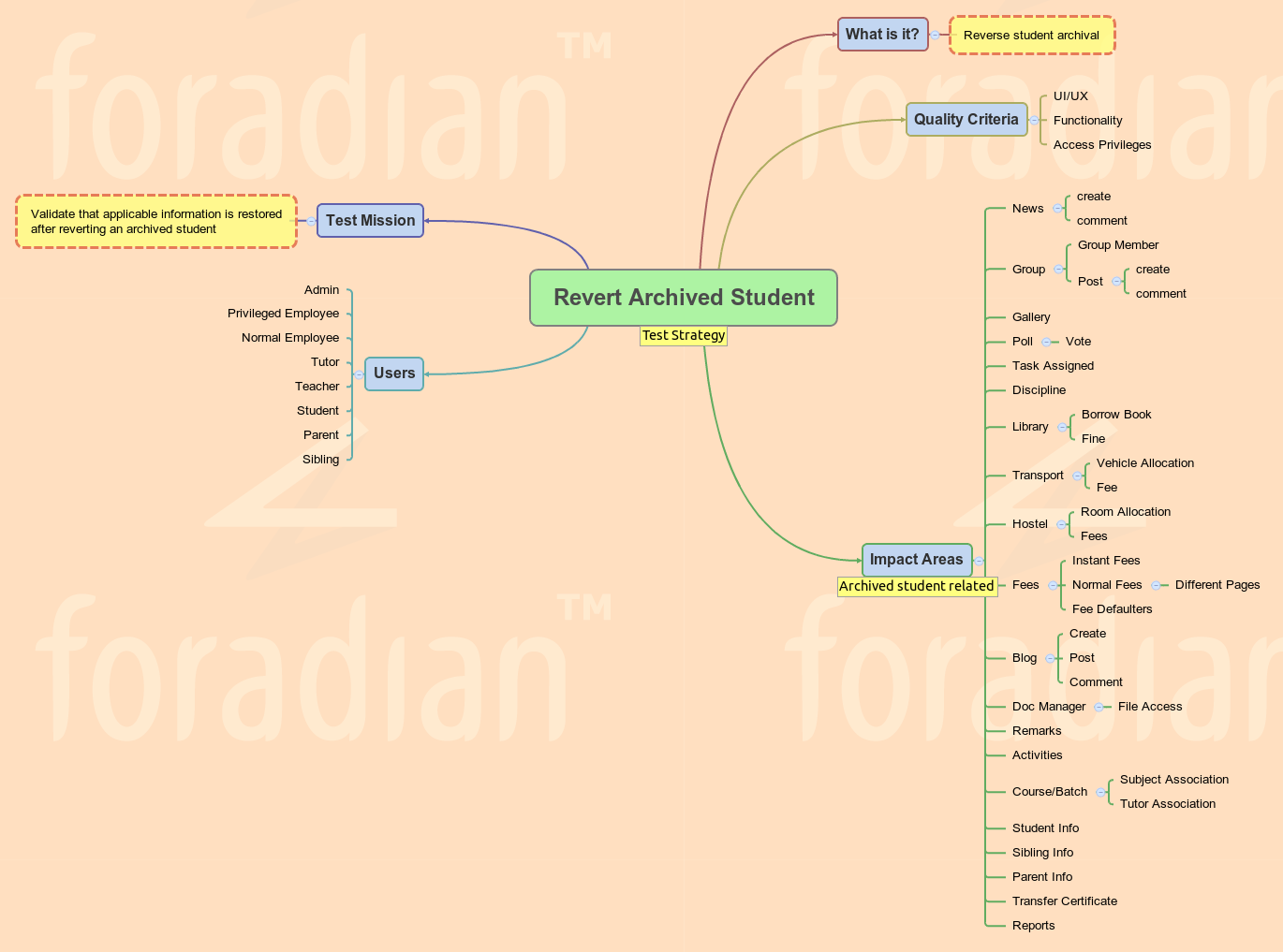
  • Implementation of the Test Strategy mind map for every feature to be tested, lists the probable areas impacted by the feature. This list actually expands our test ideas to achieve better test coverage. This would also help our developers to know and handle impacted areas across modules.
  • Following the Lean Test Documentation (Flexible excel template for listing only the test ideas and test scenarios, excluding elaborate test steps, and marking the test execution results against them) approach helps us devote less time for Test Design and more time for Exploratory Testing.

Here’s a sample Test Strategy mind map for your reference!

Revert Archived Student. - Test Strategy
To conclude with, we are committed to test your favorite Fedena much better, resulting in minimal bugs which hardly bug you, thereby giving you an enhanced user experience! Team Foradian is thankful to you for your unprecedented support and cooperation.

The article is written by:

GautamGautam M S
“Gautam doesn’t breathe air, he breathes testing instead. He is a disciple of the Context Driven Testing community and testing is his way of living. You can’t convince him without logic! He believes testing is a scientific way of analyzing things at hand!”

ERP in Education: The pros and cons of ERP implementation in education

ERP-Jan29_15 (1)

We live in a world where computers are omnipresent; technology has entirely changed the way we live, towards the better. And education is one such name where technology and the use of computers have changed the way it is delivered, completely different from what it used to be in the last decade. Other than various new learning techniques like online courses, smart classrooms; technology has equally simplified the management of educational institutions.ERP implementation have been revolutionizing institutional management for sometime now, helping institutions to improve their operations, thus making them manageable and more transparent.

ERP in education is not a new concept; ERPs were in full-fledged use in major corporations in some of the biggest industries, to ease the management process. With the development of technology and widespread demand for computing concepts has led to the increasing popularity for ERP solutions in other industries like educational institutes.

ERPs over traditional system of management

So, what gives educational ERP the edge over traditional method of management? Definitely, its the time and efficiency factor that places the software ahead of the traditional methods. Managing funds in an institution and tracking them into a report almost sounds like rocket science if done manually. A lot of productive time goes into meeting this kind of specific requirements. Moreover, management of a lot of basic operations like inventory, HR, finance and other services at times appear a complex task. Educational ERP implementation can ensure an institution function at its maximum potential.

The benefits of an education ERP system


An education ERP definitely has a lot to offer, like-

  • Cost effective: Perhaps the most prominent advantage of using ERP in education is the costing factor. Saving on the amount of man hours let you save so much on finance. Basic campus management requires a lot of manpower to manage things like fee collection, the grueling admission process, etc. When this management is done online, a lot is saved on the finance sector which can be used in other useful purposes.
  • Better organization of data: Organize your data the way you want. Education ERP gives you a lot of ways to organize data of your institution that would help in proper management of it. Data is managed well and available with a single click of a mouse.
  • Data is secured: Data or information stored in web servers are far more secured that those stored physically in shelves. Storing information and data stored by ERP software in servers have backup systems and thus, your information is preserved! Is it possible with physical storing of data and files?
  • More automated administration: The entire administration which was otherwise managed using huge manpower, involving all possible flaws that are not tracked easily and managed. With education ERP, the point of flaws in managing important administration processes like fee collection, library books, admission list, etc is nearly minimal, unless there are some human errors in filling up information or technical glitches.
  • A quicker management process: Education ERP software quickens the entire process of institutional management to great extent, lets say in a matter of seconds. All you need to wait for is the implementation of the ERP software and you are set for a faster management of your institution like never before. Be it the admission process of an entire new batch of students or generating customized reports on a particular batch is a task done in minutes.
  • More focus on education: When most of the time is saved from taking one-to-one attendance in class or filling up the mark sheet after every exam, a lot of time is saved to be invested in what is more important- teaching!

The limitations of an education ERP

Of course, there is other side of the coin too! Even if the management of your institution is available within the single click of a mouse, there are some limitations that prevents institutions to choose education ERP solutions for better management. Some of them being,

  • One failure of ERP in education can be measured in terms of achievement of Return on Investment (ROI). When the ERP implementation doesn’t yield enough ROI, it can be a failure.
  • The cost of ERP, its planning and implementation, customization, configuration, etc might be too much for lesser profit-driven schools.
  • Most ERPs are difficult to learn and use. With complicated user interface that requires thorough user training, it requires complete participation of users.

Time has come for all educational institutions to go the smarter way. Re-organize the management systems of your institutions to match the evolving technology in every aspect of life.

Tracking Student Attendance just got Easier

Fedena-Blog---DailyAttendance_b
Tracking student attendance for your institution is very important. It helps you evaluate its quality, make timely administrative and financial decisions, and plan events such as fire drills and other institutional activities. Being aware of student attendance is not only important for your institution but also for your students. Regular attendance is important to a student’s academic success. Knowing your student attendance will help identify absence trends and give the institution the necessary data to establish an action plan to change the attendance culture of an individual student or a group of students. To help you with all this, we’ve introduced the Day-wise Attendance Report as part of Fedena 3.4. On any given day, you can now easily track the overall student attendance of your institution, as well as for each batch.

Who can access the report?

Only Fedena administrators and privileged employees (either the Student Attendance Register privilege or the Student Attendance View privilege must be provided) can view the Day-wise Attendance Report.

How to access the report?

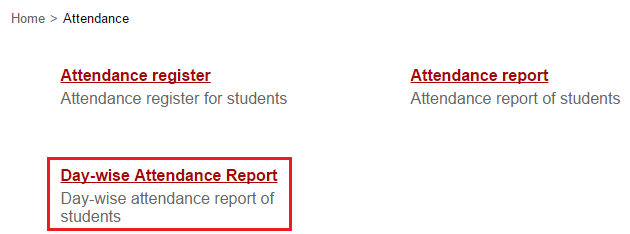
After you log in to Fedena, go to the Attendance module.
1

Remember, this report is available only if you mark student attendance Daily.

What does the report show you?

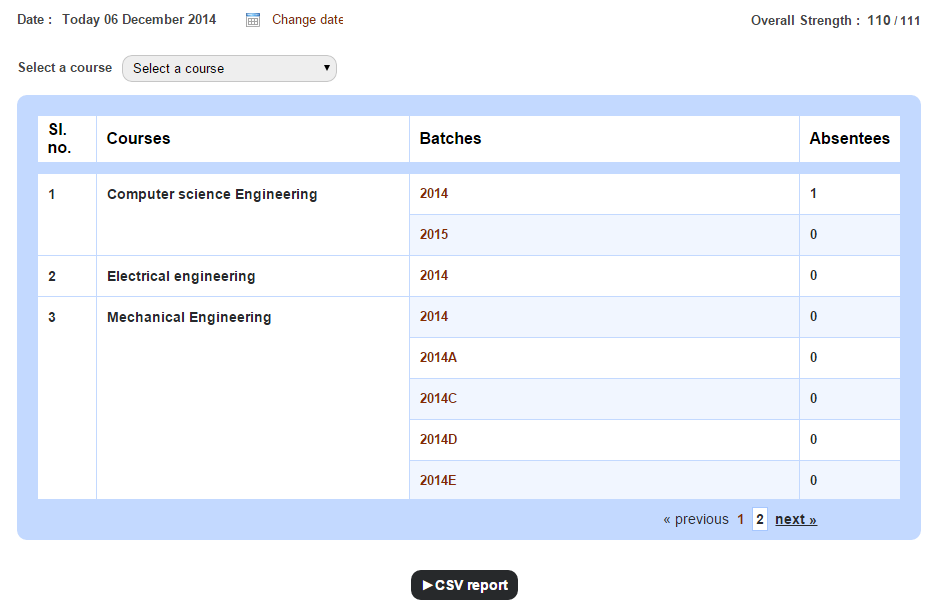
The Day-wise Attendance Report displays the number of students present in your institution, as well as the number of students absent in each batch on a particular day.
Generate the student day-wise attendance report

To view the student attendance count for a previous date, all you need to do is change the date. The Overall Strength in the top right is the total number of students present in your institution for the selected date.

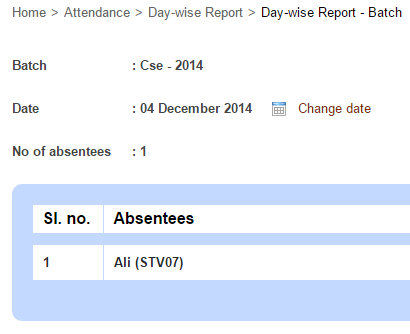
Use the Select a course field to view the number of students absent in each batch of a particular course. You can then click on a batch to view the names of absent students.

Generate the student day-wise attendance report1

To generate a CSV report of the number of students absent in each batch, click the CSV report button.