education technology tools blog

Four Unexpected Education Technology Tools That Will Transform Your Classroom

These education technology tools were under your nose all along
 
 
Education technology is growing by leaps and bounds, supported by an immense amount of credible research and backed by robust engineering. We’ve spoken on this blog before about how education technology tools and platforms are not just for the elite, but that the simplest of tools can help marginalized students learn better. But as any teacher in an underfunded school knows, making the case to purchase the latest piece of technology on the market can be an uphill battle. Assessing the needs of your classroom, comparison shopping for the most cost effective option, ensuring that it will be useful over the long-term are all just the first few steps to convincing school administrators to make a purchase you just know will empower your students. It is often a long drawn out and exhausting process. So here are a few existing tools that are not necessarily built for the classroom, but are as effective as that best-in-class dream tool you have been eyeing for months now.


Education Technology Tools


Google Docs
 
Working with Google Docs for a group project is one of the most fulfilling experience your very particular students are going to thank you for. Its auto-save option is perfect for the absent-minded kids, while it’s multiple person edit feature allows for seamless real-time collaboration. The best part is that it’s continual archiving enables you to see who really contributed what in that report you assigned – enabling you to better help students who might be flying under the radar and lagging a little behind their peers. These features can be found across most Google Apps features – from Slides for presentations to Sheets for some organization or analytical assignments.
 
 
Duolingo
 
Struggling to get your students to pay attention to their language lessons out of the classroom? What better way than to gamify it. Duolingo is one of the most popular language learning apps out there, and there is nothing stopping it from being a fun five-minute game your students play on the bus on their way to school. While it certainly is not a replacement for in-classroom instruction, it makes for a handy supplementary tool perfect for practice – one of the most vital elements to perfect learning a new language. This is by far one of the most under-rated education technology tool in the market.
 
 
Prezi
 
A big part of learning is communicating the information absorbed to an audience. Even the most enthusiastic listeners can be distracted when confronted with a dull and static powerpoint presentation straight out of the 90s. As a savvy teacher, you know that communication and presentation skills will stand them in good stead for their college career and their professional lives after. So why not give them a head start? Prezi is a presentation tool that allows students to easily create highly dynamic and engaging presentations. Using this educational technology tool will not only encourage your students to think about how to best communicate their ideas but also about how to use good design to their advantage.


StayFocused

 
Let’s be honest with ourselves – the best education technology tools stand defeated in the face of the multitude of distractions our students have to cope with. Whether it is a notification about their favorite singer tweeting or the latest meme going viral or a fight brewing on the group chat, work and pleasure are intermixed in our increasingly connected world. Tools like StayFocused enable students to be online but still stay productive by blocking certain distractions for pre-determined periods of time. Deploying tools that help you focus early can only train young brains to remain on task more easily.
 
Let us know what are the other education technology tools you like to use!

Sampoorna school management system blog image

Project Sampoorna – The School Management System Every Indian Student Deserves

Proven results in scale and effectiveness for our nation

 
Sampoorna school management system blog image
 
In 2011, the Government of Kerala took on the ambitious challenge of better serving its students by more efficiently managing their school record details. The end-goal was to make previously tiresome processes more hassle-free for all administrators, from the Headmaster at the very top of the institution management to the classroom level teachers interacting directly with students.
 
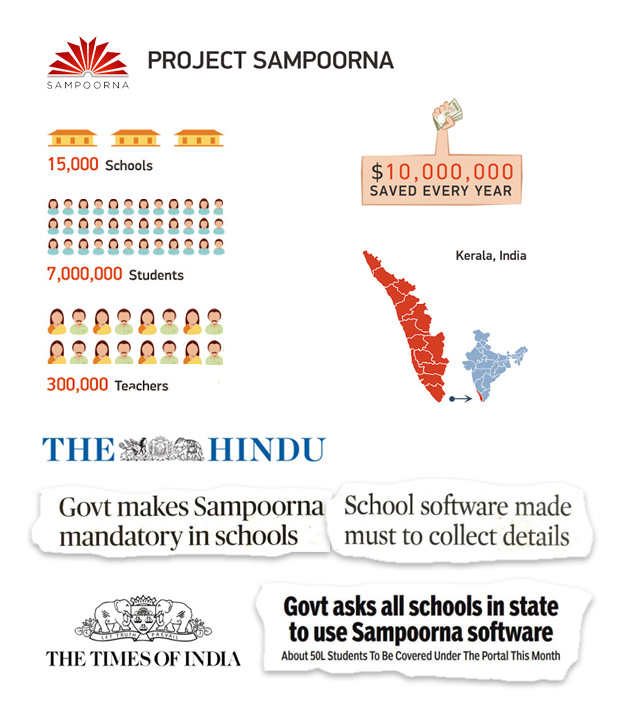
From this vision was born Project Sampoorna, a school management system that would track the details of every student in order to enable institutions to better empower them. Sampoorna was built on Fedena’s open source database and server software and was launched under the aegis of the IT@School Project in Kerala, whose aim was to leverage technology to bring about school level transformations. The numbers involved in this project only speak to its ambitiousness – over 300, 000 teachers benefited in Kerala had the opportunity to use this system to better track and manage their students’ schooling. 70 lakh student records in 15, 000 schools across the State were tracked using the Sampoorna system.
 
But why was this project so important to begin with? While the processes of yore might have seemed cumbersome, they certainly were not entirely dysfunctional. Things had been carrying on without too many major mishaps. Was this yet another effort to fix something that was not entirely broken?
 
Sampoorna in the media
 
Let’s start with a deeper than surface level look at a phenomenon most people are familiar with – the skyrocketing of school fees. This is not only a subject of popular debate at dinner table conversations, or an electoral promise made by anyone running for office, but a a primary factor in people’s individual economic decision making. The refrain from a disgruntled parent about how much he/she is spending on school for his child whose marks are not quite up to par is practically a trope now. Educational loans are one of the most utilised types of funding banks offer. Every parent aspires for their child to join a brand name school, get into a brand name college, and secure a brand name job. So it makes sense why school fees are rising and will continue to do so. There are a multitude of factors that influence this trajectory. In addition to the usual suspects – such as rising cost of living, the demand for more specialised competencies from our teachers, and the increased competitiveness students are facing with each passing day – there is a hidden cost that is not often factored into increased school fees.
 
School administration fees are often overlooked when considering why school fees are so high nowadays. In addition to property costs, schools are dealing with a greater number of administrative processes, from issuance of certificates to catering to the real-time information demands of increasingly involved parents. The sheer scale of these processes is hard to keep pace with, especially without the help of technological support. Anything that helps mitigate this cost is a win for everyone – from institutions who seem to be perennially struggling with budgetary budgetary concerns to parents who are making heartbreaking compromises for their child’s educational future.
 
This is where ambitious initiatives like Project Sampoorna come in. The robust engineering upon which the platform is built and its comprehensive technical capabilities allow schools to focus on their primary goals of educating India’s future thinkers.
 
What started off as a 100 day pilot programme in 2011 was found to be so effective, leaders in the Government of Kerala have now mandated the compulsory use of the Sampoorna school management software across the entire State going forward in 2017.
 
Educational technology initiatives are rarely this successful, especially when one factors in the massive requirement in terms of scale. Especially of note here is that this has been accomplished not by a private entity with billions of dollars of investment, but by the Government of Kerala, ensuring its democratic implementation. This is not an elitist program accessible to only a few financially blessed institutions and their equally privileged wards. Students from all walks of life in Kerala have benefited from this project and will continue to do so.
 
A second point of commendation is that Project Sampoorna has led to stellar financial outcomes – data shows that over $10 million dollars a year has been saved every thanks to the cost-cutting in labour and resources that the platform has allowed. Every dollar earned through this type of frugality at scale is a dollar that can be put towards resources that directly improve student learning and thus, student outcomes.
 
So what are the administrative functions that the State of Kerala has saved on in the last few years?
 
The processes the system can manage are comprehensive. Administrators can use the Sampoorna school management system to streamline previously burdensome processes like preparation of Transfer Certificates, copying of Admission Register, generation of a variety of student reports, generation of lists for numerous scholarships, preparation of SSLC examination database, preparation of student progress report, student class promotion lists and even entry forms for sporting and cultural events. Students and parents can keep a better track of their progress in school through the easily generated reports for parents, teachers and non-teaching staff who support student activity The system has become a necessary facet of everyday school functioning – teachers utilise the time table management feature that has been integrated into the software.
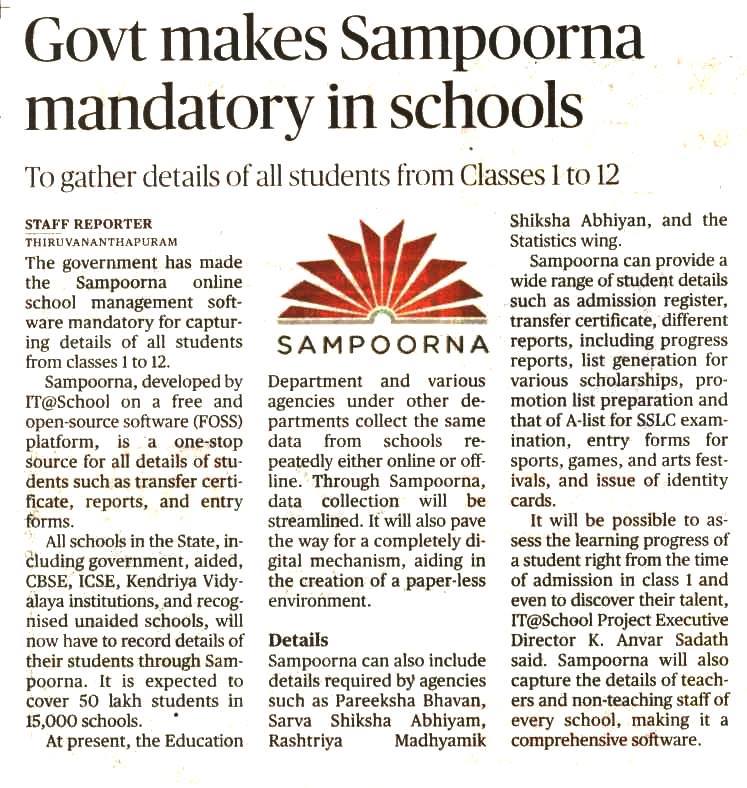
 
Sampoorna Fedena The hindu
 
And what can we look forward to from Sampoorna in 2017 and beyond?
 
Now that some existing processes have been tested in the system, the possibilities are endless. The potential of the system must be utilised at its fullest in order to ensure complete effectiveness. Whether it is ensuring its existing features to better track government spending at individual schools, or expanding the scope of the system to track more than student details, the sky’s the limit.
 
In a country like India, where various out of school factors like number of siblings, gender of the student, parent’s income, parent’s education, distance to school, nutrition(body mass index) etc. play a critical role than the quality of schools and teachers, Sampoorna has the capability to track student data that directly affects our ability to understand issues that truly affect educational outcomes for students. This data collection is the first step to implementing highly effective and personalised students. Sampoorna is also ready to manage the implementation of these students. For instance, tracking the implementation of a government scheme like the Mid-day Meal program utilises features that already exist in Sampoorna and have a proven track record of success.
 
Research shows us that education is one of the key factors in social mobility – a marker of success, especially in a country as diverse as India. For most people, education is their one route to improving their social conditions, especially for those struggling with abject poverty. Detractors might argue that spending on educational technology when students go hungry is a frivolous and foolhardy act. This is an outmoded way of thinking. Education technology helps effect real change that can transform people’s lives. It is not just a student that benefits, but their entire family, and consequently their communities. Investing in educational technology initiatives like the Government of Kerala has can make or break this country’s future.
 
Sampoorna’s robust technical capabilities and cost effectiveness at scale make it a highly reliable educational partner, especially for Governments that already have the reach that private entities struggle to match. Its success is not just limited to the State of Kerala, and visionary leaders from across the country must recognise that there is no reason to not expand it to the rest of India. This future ready platform is what students from across our country deserve.
student management system report card format blog image

Are Your School Report Cards Communicating To Parents Or Confusing Parents?

The Changing Role Of Schools In Society
 student management system blog image
 
A few decades ago, schools could be defined as fundamental centres for imparting knowledge and formation of the citizen according to the constitution. However, with changing economies, shrinking families and increasing pressure of children the role of the school in society is fast changing.
 
The role of the school has evolved to not only be places that transmit information but to encourage critical thinking, creativity and foster healthy social relationships. The schools of today are places of research, cultivating among its students positive attitudes of enquiry and a desire for lifelong learning.
 
Understanding The Purpose Of The Report Card
 
While the role of the school has evolved, the humble report card has continued to remain a paper that simply grades the students on their scholastic achievements.
For schools, the report card is an essential administrative tool that serves as a record holder of the students’ academic progress. But for parents, the report card is the most common and formal form of parent – teacher communication and hence needs to be in a format that is clear, easy to understand and universally acceptable. It is vital that the report card of schools be meaningful for parents as accurate evaluation and communication of the students’ progress in school is crucial to the students learning.
 
Communication Or Confusion?
 
Despite the fact that all schools have the same goal of facilitating learning, different schools have adopted different designs for their report cards. While local schools offer simple formats that include a brief summary of students’ performance in school, the international schools offer more detailed reports with in-depth narratives of student performance, analysis of strengths and weakness, records of awards together with testimonials from teachers. Some schools also provide attendance records, behavioral records and other non-academic information in their format.
 
However, with so many schools, often within the same education board, and school district offering differing report card formats, evaluating a report card can be quite confusing for parents. While on one hand, some report cards are overwhelming with their pages of information, on the other hand, the lack of data in the more simple report cards can leave the parents longing for more information about their child in schools. For parents, whose children are migrating to a new school, the lack of standardization, and disparities in the system are creating further confusion.
 
With so many report card formats floating around, how do parents then compare the performance of their students to the norm? How do migrating parents deal with the confusion? How do school accepting migrating students compare and analyse their performance?
 
Is a society, where kids are often judged by their report cards, differing formats and evaluation methods can be confusing and often hampering to the student academic progress as well as self-confidence.
 
Is Standardization Of Report Cards The Solution?
 
Earlier this year, the Indian CBSE board released common templates for report cards to be issued by all CBSE schools. The aim of this move was to standardize evaluation of students across schools.
 
According to the new format, the report cards for classes VI to VIII will be identical with rows which specify the terms, periodic, notebook, subject enrichment and half yearly/ yearly marks scored in each subject and the corresponding grades. It will also have co-scholastic assessment where students will be graded on a 3-point scale
 
This marks only the first step towards standardization of report cards, ensuring transparency about strengths and opportunities, and establishing a common platform that evaluates all students equally.
 
As schools preparing our kids for the future, our reports cards to need to be equipped for the future. As an educational institution, are your report cards a comprehensive guide for the parents or a confusing sheet of paper? What progressive changes would you like to see in your school’s report card?
 
Do email your report card to us at support@fedena.com and let’s discuss ways to create standardized reports cards that will help parents and students get a complete understanding of the learning of a student.
 
Are you a parent struggling to understand your child’s report card? Do share your experiences with us.

Fedena Report card #ultimatereportcard

A Report Card Built For Parents

Better design can result in more comprehensive report cards


#ultimatereportcard
 
For your average parent, the report card is the first and oftentimes only reference we have to assess how our child is doing in school. It is a tangible piece of evidence that becomes a signpost in their educational journey.
 
When stripped down to their essence, most report cards contain the same basic elements of information:
 
1. Subjects the student is studying
 
2. Scores or grades received this semester in the last examination held for these subjects
 
Beyond this report cards can also contain the following elements, amongst others, whose aim is to give a more comprehensive picture of a student’s progress in the classroom:
 
1. Comments from the teacher explaining the student’s performance with more nuance or context
 
2. Scoring or grading of skills outside of the student’s knowledge of the subject at hand (punctuality, discipline, etc.)
 
3. Percentile scores, to give parents an idea of how our child is doing compared to their peers
 
Most parents are worried about two things – that our child do well, and that they do well relative to their peers. Striking a delicate balance between the providing information that immediately tells us how our child is performing, while also ensuring that the optional information provided only adds to this knowledge is an art.
 
Report cards tend to err in both directions. They either report too much, muddying the waters and confusing us parents on the course of action they need to take with regards to our child’s schooling. Or they don’t tell us enough, with stark scores that don’t really provide enough context to situation a student’s performance in school. A given score may look exceptionally low until context is provided that helps us parents understand that our child is in the 99th percentile of the class, and the score is low due to the nature of the subject, or harsher grading.
 
What’s missing here is a standardised understanding of what a good report card looks like. The variance in design and information means that there is no defined standard across schools and education boards that us parents can compare with. It also means that we, as parents, might be missing out on information or suffering from information overload due to bad design without even realising it.
 
A simple example of this is scores versus grades. Over time, in India, we have seen shifts in favour of each style of assessment. Indians seem to like scores in their report card as it gives them a concrete, quantitative idea of how our child is doing in class. Over time, however, many institutions moved towards a letter grade, as it helps categorise students in a band, giving a better idea of their performance relative to their peers. In India, where the pressure to perform in school can reach dangerous heights, it was thought a letter grade would also prove to be less embarrassing and stressful for students. While the alleged futility or success of such an exercise is the subject matter of another blog, this variation has caused immense confusion for parents. While they might have a reference key that explains these grades relative to that of our child’s peers, when it comes to assessing their performance vis a vis that of students in another school, or across the city, or under a certain educational board, the system falls apart. Scores fare slightly better in being more easily comparable, but aren’t foolproof – different education boards and schools score with varying degrees of rigour, which puts us parents back at square one.
 
The only way we can ensure that we parents get the most out of the report card is by pooling together our collective knowledge. Over the years, every report card we have seen has either added or taken away our understanding of how our child is doing in class. Why not share the possibilities of how a report card could look, and then pick and choose the most informative and useful elements to build a report card to beat all other report cards once and for all?
 
Crop or anonymise any personal information and share your report cards at the link below/in the comments/on social media pages using the hashtag
​#​UltimateReportCard. The time has come to build the mother of all report cards, and this time it will be designed by those who rely on it the most – you and I, the parents.

Fedena edtech humanities

The Role of Education Technology in the Humanities

How the state of the arts can be improved with education technology
 Fedena humanities education technology image


Education technology products proliferate the market today, but most of them are focused on learning in the areas of science, technology or maths. The humanities are often sold as subjects that require memorisation of vast quantities of boring information or something people instinctively just “get” due to having early access to cultural capital in their lives. The state of humanities education in India is abysmal to begin with and stereotypes like this do not help the cause. An increase in appreciation for the arts cannot be accomplished without a parallel increase in accessibility to avenues that will help us understand them. Currently, this happens in silos that merely seem to cater to populations that already have a stake in the game or are proactive enough to seek them out. It is completely inaccessible to large swathes of the population who are not even cognizant of its existence.
 
This is not to say there are no tools for people seeking to improve their reading comprehension or writing skills. Websites like Free Rice have gamified vocabulary building, and are fairly addictive to boot. 700 words encourages consistency in writing everyday – a key to becoming a proficient writer. But educational technology products, platforms or tools seem to reflect the interests of their creators, and are largely focused on STEM (Science, Tech, Engineering and Mathematics) fields. So what is an aspiring writer or budding historian supposed to do? While we wait for this field to catch up, here are Fedena’s top three tools that will engage arts-inclined students in our educational institutions, from kindergartners to those completing their PhDs:
 
Grammar Gorillas
 
Chuck your Wren & Martin – education technology tools like Grammar Gorillas have gamified something as boring as learning grammar. Its fun and interactive nature makes learning grammar with its intricate rules easy and interesting. Students keep coming back for more which guarantees that good grammar will stick, thanks to all the practice. While this helpful tool is geared towards younger students, a strong foundation in English grammar will stand them in good stead for the rest of their educational and professional lives.
 
Essay Punch
 
Remember those 15 mark essays from school? Most students assume that a 10 out of 15 is the maximum score they could potentially get. But why not aim higher? While essay writing might seem like an archaic skill to develop in this day and age of WhatsApp and instant messenger,being able to articulately and convincingly put across your point, no matter what the medium, is a skill everyone can stand to develop. Essay Punch essentially breaks down how to do this. From encouraging students to think of their essay’s thesis in order to ensure the final point of the essay is crystal clear, to providing guidelines at every stage of the essay writing process, Essay Punch is an education technology boon that even former students can benefit from.
 
Smithsonian’s Picturing the 1930s
 
The historical Smithsonian Museum’s Picturing the 1930s is a great example of how existing institutions can use education technology to reach wider audiences. The website allows students to explore 1930s America and interact with elements of existing exhibits to learn more comprehensively about this defining era. What’s unique about this platform is that information sharing is not a one way street – students interact with primary historical resources to get a sense of what it was like to live in those times. History coming alive has never been more within the reach of everyone – especially for those who might not be able to travel to or visit museums like the Smithsonian.

Fedena engage blog

4 ways to use classroom technology to engage students

Classroom technology might be the solution to this age old issue
 Fedena engage blog image

 
Ask any teacher, and they’ll tell you that a balmy Friday afternoon class, right after lunch break, is not exactly conducive to teaching the nitty gritty of how sound travels – even to the most eager future-physicist. Getting students to pay attention in class can feel like an uphill battle. This is not a new problem teachers are struggling with either. In the past, it has lead to the birth of some classic classroom practices – from field trips that provide context to that otherwise boring history lesson to reward systems that rely on gold stars and special privileges to motivate more competitive students to learn.
 
Student engagement is also what sets good teachers apart from the best – one my favourite teachers when I was in school was my biology teacher who, despite his sonorous voice, managed to keep us all on our toes by catching us unawares with his silly personifications of parts of the human body. These days, however, teachers do not necessarily need to be trained in the theatrical arts to engage their students. We can now rely on classroom technology to capture their imaginations, and thus attention. Technology enables us to do this at scale while still remaining cost conscious. This is especially effective with a generation that has grown up with technology from the womb. To them, it feels intuitive – the learning curve for new technologies is not as steep as it would be for older generations and it is, frankly, more stimulating than your classic textbook oriented teaching methodologies.
 
Here are four ways you can use existing classroom technology to re-energize your students into loving what they are learning:
 
Increasing in-class engagement
 
One of the most powerful moments during teaching is the first time a student hears about a new concept. For most, this happens in the classroom – when we teachers introduce a new idea to the student for the very first time. This can often feel like a one-way process, which is not conducive to high levels of engagement. Using in-class classroom technology tools like polls, shared boards on which students can write, etc. engages students more meaningfully, ensuring that they are paying attention, and learning the material well.
 
Enabling peer learning
 
Studies have shown that students’ grades are positively influenced when they learn from their peers.Teachers have long relied on teaching methodologies like group projects and student-led group discussions to capitalise on this, but with modern classroom technology the barriers to these methods are only decreasing. Students no longer need to be limited by time and geography in their learning. Platforms like Fedena allow students from across the world to form study groups centered around a subject or interest.
 
Creating a continual feedback channel
 
Students are often blind to how well they are doing in a class, until exam time rolls around. This can be detrimental to a student’s progress since they have no way of assessing how well they are grasping the material. Classroom technology, like Fedena, enables teachers to give continual, one-on-one feedback helps students understand exactly where they are excelling and where they should channel their energies to do better.
 
Personalising learning
 
Studies increasingly show that personalising learning results in better student outcomes and is the way of the future.Detractors may questions the practicality of hyper-personalisation but classroom technology allows us to engage with students at a granular level. From giving one-on-one feedback on homework assignments, to being easily be able to assign coursework that the student learns at their own pace, to even being able to assist the student in real time through personalised messaging and video-calling, classroom technology is rapidly becoming the backbone of good teaching.

Fedena school erp blog image

Important Factors to Consider Before Developing a Website for Your School or College

Are you thinking about developing a new website for your school or college? Having this online facility is an effective way to communicate with parents, current students, future students, and past students. However, there are certain factors you should be aware of before you decide to start this type of online project. Below are some of the most important factors to consider before developing a website for your school or college.
 
fedena SMS blog image

 
Technical Considerations
 
Before you can start to add content to a website, there are some technicalities you have to deal with first. You have to decide what to call your website and purchase a domain name that features that website name. Once you have the domain name you want, you need to purchase a smart hosting package where your website will be stored and where you can set up email addresses for your school or college. The hosting provider should be reliable and fast so that your visitors have the best online user experience possible.
 
 
Platform
 
Choosing the right platform for your website is the next important step you need to take. If you intend to simply use your website to update people and publish content, a blogging platform should be sufficient. However, some schools and colleges want more functionality than that and opt for some kind of Learning Management System. However, these systems can be complex in nature and you need to be aware of the additional support these systems require.
 
 
Designing the Website
 
Someone with a technical background will be required to create your website. Before you hire anyone to do this type of work, check their previous work, make sure they offer a competitive price and provide adequate technical support.
 
 
Administrators and Contributors
 
When you have installed the appropriate platform, you have to decide who will maintain and add content to the new website. You can do this internally by getting staff members and students to contribute or you could hire an external content creator to do this work for you. In most instances, it’s a more affordable and practical option to get people involved who are directly associated with your school or college.
 
 
Cost
 
Like any purchase or investment, you have to understand fully how much a project like this will cost. Prices vary, depending on the type of platform you install and the amount of ongoing support your website requires. This is why it’s essential to be aware of all of the costs associated with this type of project before your school or college goes ahead.
 
 
Website Policies, Security and Safety
 
Most school and college websites feature news and information about a large number of people. However, you should ensure that you set down certain rules that people have to follow when it comes to publishing text, images, videos and other content. If possible, you should also avoid storing personal information about students, staff, and other individuals that could be used in a harmful way if it gets into the wrong hands.
 
A website is a valuable asset for a school or college. However, you need to plan and be aware of all of the points above before you finally decide to go ahead with this type of project.

Fedena School ERP support desk

Fedena Support Desk: The CBSE Assessment update

“Adapt or perish, now as ever, is nature’s inexorable imperative.” – H. G. Wells
 
Right from the day CBSE announced its plans of the Uniform System of Assessment, we have been receiving a flood of tickets and emails from all our clients on similar lines. This made the R&D Team dive straight into immediate action on how Fedena can strive to be at par with the needs for an examination module of 18,688 CBSE Schools. The research of the various facets of the new pattern was aimed to identify and fixate upon the best possible roadmap to incorporate the latest changes in the least possible time. And being in the EdTech Industry for the last 8 years we have definitely understood that timing holds the key to Customer Success for sure.
 Fedena School ERP support desk
 

In the quest to cater to the needs of the Schools on the concern, we have made some significant developments. So We present here 5 points for a sneak peek of the improved examination module.
 
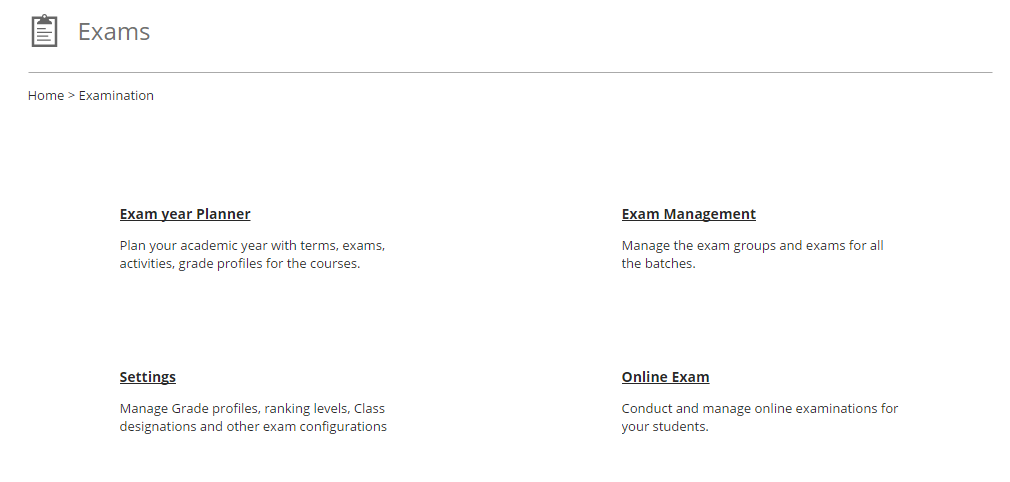
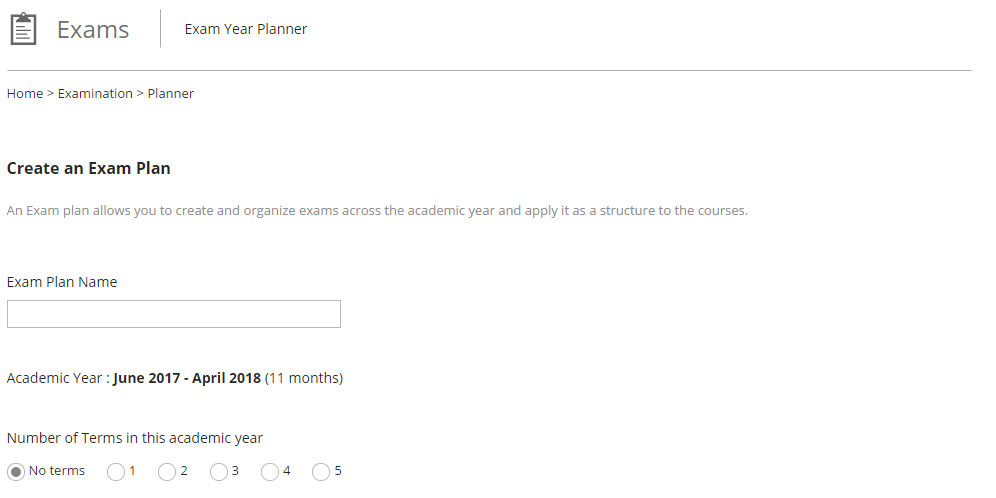
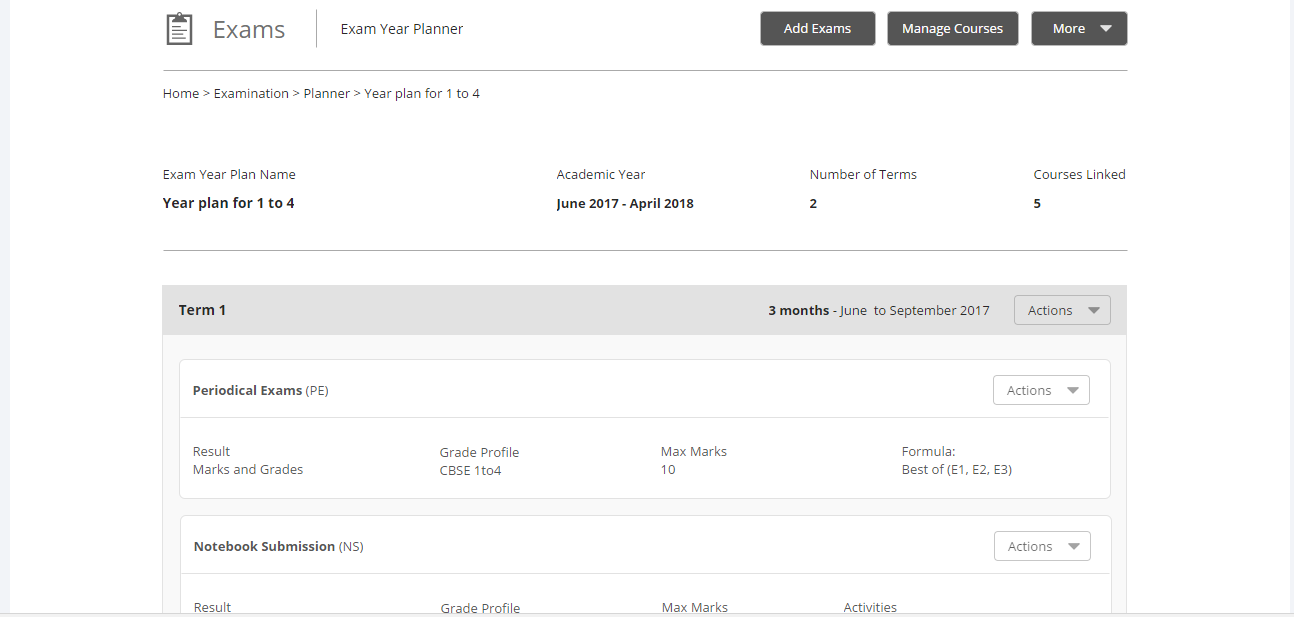
Exam Plan: We have an Inclusion of a top layer above Exam management which would not only let the user plan the Exams on the School’s timeline for the whole academic year but would also let user fix upon the Terms for different classes. So, while the Classes VI-VIII have two terms, class IX will have only one term to be created.
 
Fedena Exam screenshot image
 
Exam Term: All the terms or exam groups will be available for further subdivisions as Periodical Exams, Note Book Submission, Subject Enrichment Activities and Final Exams. The user gets to add the Exam type, Maximum Marks, and Activities for each one of the terms.
 
Fedena Exam screenshot 2 image
 
Co-scholastic Areas and Discipline: Even the Co-scholastic Areas and the Discipline section can be created with the similar architecture, thereby eliminating any complexity in the creation and updating Exam scores.
 
Fedena Co-scholastic screenshot image
 
Grading Scales: Most Important of all the above, the 5 point and the 3 point grading scale for co-scholastic areas and the discipline has been worked out for the relevant classes, where the user has to choose from a set of pre-created grading scales.
 
The Instructions section and the important signatures have already been a part of the application, which would need small tweakings to stay up to date with the latest formats.
 
In a nutshell, we have been working like a war front to get these feature up and running for you. Subscribe to our Blog for more updates from the Fedena Support desk.

Fedena 3.5.4 dedication blog image

Ganymede : Fedena 3.5.4

Fedena 3.5.4 – Ganymede is out and we hope you are as excited as we are. This release brings a fresh, new applicant registration module with a whole bag full of new features and enhancements while removing some not so used features as well (it was a tough decision). Version 3.5.4 also has 2 important features you have asked for: Particulars and discount reporting of fee collected in finance reports and Leave groups for different leave types.
 
Over the past few releases we have been naming our releases after the satellites of different planets and dedicating it to a famous (often forgotten) teacher who made an impact in their field as an educator, researcher, and a leader. We are excited to dedicate this release to Madhava of Sangamagrama, a mathematician and an astronomer from the state of Kerala, who lived around (c. 1340 – c. 1425) . As with many other Indian mathematicians, he is now increasingly attributed to many theories which made their way to Europe much later. His greatest contribution is towards the formation of the Kerala school of astronomy and mathematics. This school gave many important mathematical concepts particularly in the infinite series and calculus in its quest to solve astronomy problems.
 
Fedena 3.5.4 dedication blog image
 
Most notable among them are the various Madhava Series (originally attributed to many western researchers and now known together with Madhava) which are a collection of infinite series expressions. You can read more about Madhava and the Kerala School in this 1977 paper by another famous contemporary mathematician from India – C T Rajagopal. The work of these educators and researchers form the foundation of many of the advances we have seen in science and technology and will continue to be for the years to come.


What’s new in Ganymede?

 
1. Application Registration Module
 
2. Leave Groups


What’s updated in Ganymede?

 
1. Application Registration Module
 
2. Employees as complainer & complained against
 
3. Improved Fee reporting
 
4. “/” in admission number
 
There have also been a number of issues fixed in this release, you can find them in the Fedena 3.5.4 Release notes.


The All New Application Registration Module

 
The new applicant registration comes with many new features like customizable form fields, custom status to handle different stages of the application process and also options like instructions to fill the form, labeled file attachments to help users. We are also deprecating 3 features which were not used as much over these years.
 
They are
 
1. The PIN based applicant registration system
 
2. Subject based registration and
 
3. Approval process
 
All your existing PIN based applications will become normal applications and the amount from the subject based registration will become the registration amount. For the approval process you can now make use of a much better system, the custom status and mark different stages of the application. We hope these changes will increase the functionality and the application of the module. As always we would like your inputs on how we can make it better.
 
For a detailed understanding of the new Applicant Registration Module you can check it out in our previous post or get in touch with us. You can find the release notes here.
 
 
What’s coming up?
Our team is already working on a host of new features that will enhance your experience with Fedena. A mobile application for admins, students and parents is getting rigged in our workshop. The features you have requested will soon be live in Fedena, the number one school management system.

Ganymede : Fedena 3.5.4 Release Notes

Ganymede_Release_Note (2)
 

What’s new in Fedena

Here is the list of new features included with this release of Fedena 3.5.4

Feature Description User Role Module
Applicant Registration Customize forms, configure custom applicant status, add instructions to fill up the form and also capture organizational level details with the new applicant registration module. In addition to the features it now has a fresh and easy to use interface which makes the process of handling new applications easier than ever before.

Note: PIN Group, subject based registration amount and approval system has been deprecated. In place of approval system, custom status allows moving applicant to different stages of approval.

Administrator, Privileged Employee, Unregistered User (Applicant) Applicant Registration
Leave Groups Create leave groups to group different leave types and assign employees who share similar leave types. Administrator, Privileged Employee Human Resources


What’s enhanced in Fedena

Here is the list of enhanced features included with this release of Fedena 3.5.4

Feature Description User Role Module
Employees as complainer and complainee Now employees can be added as complainer or complainee in discipline module Administrator, Privileged Employee Discipline
Improved fee reporting Fee reports in finance now comes with particular wise amount collected and discount given. Fees collected is split among different particulars in case of partial payment to give the correct report. Administrator, Privileged Employee Finance
/ in admission number Admission number now supports the / symbol Administrator, Privileged Employee Student


Issues Fixed

Here is the list of issues fixed in this release of Fedena 3.5.4

Attendance

  • Unable to mark attendance for elective subject after deleting attendance and trying again.


Custom Import

  • Spaces before and after data are truncated during upload of data.


Employee

  • Employee additional details not showing in PDF report.


Exam

  • Issue of inactive batches not shown in batchwise exam report.


Human Resources

  • Loss of Pay amount not showing when editing a rejected payslip.


Online Exam

  • Validation added to options in objective type online exam.


Student

  • Removed default date for guardian admission form.
  • Date of Birth for guardians set as blank instead of default date.


Settings

  • Added support for new TLDs in list of allowed email ids.


Timetable

  • Timetable summary not showing when employee removed from created timetable.


Transport

  • Fixed issue with transport fee defaulters who made partial payments.


questions to ask yourself before buying ERP fedena blog

6 questions to ask before investing in education technology

Not all education technology is created for you
 
A couple of weeks ago we spoke about the six cool educational technology gizmos we really, really want to get our hands on.Now every person needs their cool toys, but education technology products are not the latest hoverboard or drone camera for adults to geek out over. They need to actually serve a purpose and address a need that can’t be fulfilled by existing solutions. Plus, not all education technology holds water and schools are not exactly known to have the deepest pockets. We owe it to our students, teachers, and parents to invest funds wisely. So here are six questions to ask yourself before investing in the latest education technology product taking the learning world by storm:
 
Question 1: What is the product made to accomplish and what is my intended use?
 
While Indians are the champions of jugaad​(plumbing leak sealant makes for excellent, and very resilient, sculpting material, for instance), investing in an expensive piece of educational technology that we never end up using is quite the disaster. Do your research (read: internet sleuthing) and ensure the product you are purchasing actually addresses your need. There really is no need to buy expensive drawing tablets for your art class when cheap easels from the local art store will do. They’ll all end up being used as glorified coasters.
 
Question 2: What is the research going into the product development?
 
Education technology products must be built in consultation with the target group they are ultimately serving – students, teachers or administrators. The product might be built by the best technologists in the world, but the people who understand the issues that need addressing must define the purpose of the product. Checking on the research and thinking behind product development will help predict how effective it will be in the classroom.
 
Question 3: Will I need to purchase ancillary products to use this one?
 
No one intends to join a cult when they purchase a product, but sometimes it just happens. Buying an education technology product from a particular brand should not entail the purchase of all their ancillary products. Investing in one item is expensive enough for a school (most are perennially suffering from a budget crunch and hardly have money to throw around). If the product you intend to purchase requires you to by eight more bits and bobs for your to really be able to use it, consider alternatives.
 
blog image fedena school ERP
 
Question 4: Is this product sustainable?
 
A temporary problem requires a temporary solution, not spending on an expensive piece of education technology. Your purchase must address an endemic issue or make life easier or more efficient for the foreseeable future. Yes, technology becomes obsolete with time, but the end should not already be nigh. A product purchase is only worth it when you reap benefits for a long time.
 
Question 5: What is the post-purchase support provided?
 
Great, you found your dream product. You’ve answered all the questions above the way they should have been answered, even found this nifty discount code, and are ready to hit buy so the little shopping cart icon does its little happy dance. But what about using it? Is the product easy to use? Is comprehensive training provided? Is their customer service responsive? These are not necessities for every piece of education technology being purchased, but they certainly make for some great perks and might tilt the scales in favour of one product over the other.
 
Question 6: How secure is my data?
 
Education technology, from its very inception, deals with sensitive data. Whether this is student scores, parents’ financial records for parents, or teacher contact information, you must be confident that this data is being stored securely. Vulnerable data being leaked could spell disaster in terms of security as well as institutional reputability.

sms fedena school erp blog image

Automating communications with your School ERP and SMS

For every school or institution, one of the most important building blocks is their communications. How admins communicate with each other, how the management is able to communicate to the faculties, how the school is able to communicate with parents and students. In this day and age of information, WhatsApp and the internet, almost everybody wants information to be communicated to them instantly without any delays. And in such a busy world how are schools to stay ahead and relevant.
 
SMSs keep parents & students informed about your institution. You can share urgent information about emergencies, fee collection dates, examination dates, let people know about an emergency holiday, availability of transport, or invite them to events. There are many applications to SMS services for an institution. Let’s see a couple of use cases which are very common.
 
In the case of Attendance
 
In a class of 60 students, there are students who are absent for the day or for the first hour and need to be filtered out of the register so that an SMS can be sent individually to the each of these absent students and their parents only because you have a separate SMS vendor application.The work that needs to be done here is time-consuming and at most times isn’t a notification which goes out instantly to the parents.
 
attendance image
 
By integrating the SMS packages with Fedena, the teacher can mark the student absent in the system and an automatic SMS will be sent out to the concerned parent notifying them about the absence of their ward from the school. If the teacher doesn’t have the time or access to the system while in the class, anyone of the admin staff can mark this in Fedena from the register even before the first period of the day has ended.
 
In the case of Cancelled Classes or Swapped Classrooms
 
It isn’t any more of a surprise that almost all the students in the school have a mobile device of their own. More often than not, classes in institutions keep getting canceled, swapped out for various reasons. In colleges especially, whenever a lecture is canceled or swapped with some other lectures, the students get to know only when they arrive.With the SMS settings in Fedena, now teachers and admins can notify students immediately of the cancellations and swaps by sending the students an SMS in time, allowing them to be prepared for the right lecture.
 
In the case of Emergencies
 
Unforeseen circumstances can demand the management of the institution to take decisions and circulate information to the students at the earliest. For example due to a sudden rise in temperature this year the government asked schools to shut down. Informing parents and students about this emergency holiday is a matter of high priority so that their time isn’t wasted. A simple manual SMS sent using Fedena school ERP will help your institution get the message out as soon as possible and on time.
 
We cannot stress enough on the importance of having an SMS service for your institution. Especially if you integrate it with Fedena. Most of our clients are already benefiting with our SMS packages. Our starter pack includes 1 Lakh SMSs with unlimited validity @ only 12p/SMS.