With Fedena, we are relentlessly focused on two things: our product and our customers. Keeping this bond is what keeps our business alive and successful.
Thankfully, in the recent months, we have arrived at a solution for the need of Enquiries for a school as well as the much needed update the Applicant Registration module needed. We are calling it the showstopper update of 2017.
So we don’t get a Enquiries module? If that’s your first reaction, bear with us. It might sound far fetched but the updates we will be rolling out in the next couple of weeks will completely change how the applicant registration module looks and works like presently. But we approached this with strong assertions any institution might agree with.

Priorities : Ease of use and application is our top priority for Fedena and always will be.
Feedback Loops : Great products are solutions built by the product team as well as the customer feedback.
Perspective : Engineers, designers, product managers and customers must be on the same page about the problem.
If you agree with the above, read on to see how we approached the problem.
Journey to the embedded module – Improved Applicant Registration
Customer support turns you into a generalist. You are asked loads of questions and pulled in various different directions. By the end of the whole cycle, you are sincerely confused if you are representing customers in the next product meeting or the product. But over time you are able to sift through and become a product expert. You start studying the usage of different modules, the applications of the product and it’s various modules in real time scenarios of customers, allowing you to come up with updates and changes the product/module needs to better help the users.
Recognizing the need for an enquiry module in institutions and the need to update the applicant registration module, we decided that it would be best to update the existing applicant registration module with the following updates :
Customizable Form: Apart from the bare minimum fields to admit a student, all other fields can be disabled or enabled as per requirement.
Notifications: Better notifications will be given to applicants on submitting the form, being accepted to the course or being rejected.
Internal Form Management: Fields and Custom status will be provided so that office level data can be managed. They can be configured for each course as per need and will not be visible to the applicants.
Preview and Submit: To prevent accidental submit with incorrect entries, a preview option is provided with each form.
Other changes: Select number of guardians required, improved document submission option and Instructions for applicants are some of the other planned changes.
Championing the customer
Now these updates will help institutions in completely customizing their applicant registrations processes using Fedena and at the same time provide the much needed enquiry module applications. This was done with careful consideration from our customer feedback, feature requests and bug reports.
The new update rolls out in a couple of weeks and we will have a new guide ready with our support team as well as our sales team for all your queries and understanding. We are still experimenting and working on a lot of new things for Fedena, stay tuned for further updates on your most trusted school management software.
5 Education Technology Gizmos You’ll Want Today!
Education technology that isn’t just useful, but cool too

We’ve previously talked about why education technology is so important for learning in a diverse, changing, multi-cultural, globalised world. But let’s be super honest – all the cool new toys coming out of it are just so much fun too. Don’t act like you haven’t been mesmerised by your collaborators turning your silly thoughts into a proposal on a shared document, or haven’t sometimes caught yourself playing your child’s educational games.
Below are some of the coolest and most fun education technology toys we love:
Smart Board
Those who’ve had the opportunity to experience this uber cool product need no explanation. Somewhere between a ginormous tablet and one of those cool magic erase whiteboards we played with as kids, this product is sure to enhance the experience of every single person in the classroom – student, teacher, and administrator alike. Whether it’s sending all your free-form notes from a brainstorm session directly to your email as a PDF, or experiencing the magic of limitless imagination thanks to endless white space, we kind of want a smart board in our house – for no reason. Yeah, we’re officially fangirling education technology now.
eBeam Edge
Smart Board too out of your reach? No worries, we aren’t zillionaires either. The eBeam Edge allows you to essentially turn any whiteboard into a budget Smart Board. All you need is a projector and a computer. This seems perfect for class discussions – project a presentation, doc, or web page and let those opinions fly. The eBeam Edge allows you to mark up anything, turning it into your own virtual scrapbook. It integrates well with existing tools like Powerpoint presentations and Word documents and helps you customize your own dashboard of icons and images. Say goodbye to cramped notes in the margins of your textbooks and worksheets and hello to slick, intuitive, useful education technology.
Livescribe
It’s not just classrooms that are getting to play with some cool education technology. All those doodles are works of art you can save now. Research shows that physically taking notes in class aids understanding and recall of the subject matter being taught. But who has time to pore through reams of paper, when cloud computing and shareable docs have made dead tree notes so obsolete? Enter Livescribe, a notebook that records all your notes as they are and stores them for you in electronic format. It’s your buy once for life notebook. And you still get to look like a hipster artist who does things old school.
iClicker
You know those super annoying Buzzfeed quizzes that you can’t help but take? Humans seem to be addicted to self-indulgent quizzes, or maybe it’s just the rhythmic click-click-click that keeps us coming back. So why not bring this to the classroom? A funny poll can only liven up the French Revolution, right? Administer multiple choice quizzes, get quick feedback from students, and even let them liven up their presentations with this piece of education technology.
DreamBox Learning
Proficiency in mathematics in no longer just something born out of rote learning or through a combination of sweat, blood, and tears. DreamBox Learning is a platform that intelligently adapts to how any student between kindergarten and the 12th grade learns his arithmetic and algebra, and it has been found to be highly effective. It isn’t another cool new toy to play with, but this education technology platform can really help people learn to love what was once a much-feared subject. And that almost makes it cooler than some of the gizmos on this list. Hey, we said almost!
5 Reasons Kids Today Need Classroom Technology
It’s a new world – Classrooms aren’t what they used to be.

Robotics labs and teacher holograms might seem like frivolous marketing tricks used by private institutions looking to justify their exorbitant fees. Do your kids really need to work with local artificial intelligence start-ups building their very own robot dog for a 7th standard science fair project? Is it even teaching them a subject’s basic fundamentals as rigorously as you were taught? It all seems a little too much.
Classroom technology, whether it is Skyping with your sister classroom in rural Uganda to learn about farming techniques in the region, or having access to some of the best technology to help build that robot dog, is more than just a cool extracurricular to include in your college applications. Here are five reasons your children need classroom technology:
1. Their generation grew up with classroom technology
Depending on how old your scholar is, it is highly likely that they were the first generation experiencing developmental technology from the very womb. Whether it is carefully planned music and teaching modules to be played to the mother’s belly during her pregnancy, or an app that promises that your diapered infant’s first words will be “je ne suis pas une pipe”, kids interact naturally with classroom technology. It was their first teacher, so why not continue using something they already instinctively learn from?
2. We have more things to learn than ever before
The sheer amount of information we now have access to is staggering. Libraries will always have an important role in every student’s life, but real estate is costly, and classroom technologies are indispensable. They give you access to resources that cover chasms in knowledge at a fraction of the expenditure investing in physical resources would entail. Wikipedia is oft-derided but is the first point of learning for students world over – whether they are sitting in a fancy Silicon Valley private school classroom or the one room hut that schools students from the surrounding five villages in rural India.
3. Catering to different learning styles
Not all students learn the same way. Earlier, we focused on teaching to the majority, assuming that those who couldn’t keep up were merely weaker students. Research has shown that different learning styles exist and it doesn’t make sense to exclude entire swathes of students in a globalised world where specialisation in obscure areas is king. Classroom technology is an economical way to teach diverse students.
4. An increase in new job roles
As the world grows older, it grows more complex – and so does its requirements. There has been an explosion in the diversity of skills required to keep our world functioning smoothly. While doctors and engineers remain popular professions, advances in the field mean that our understanding of these roles has become more specialised. Classroom technology aids us in understanding this granularity – whether it be an advanced microscope in our labs that helps us better understand our future geneticists understand the building blocks of our body or machines that let us experience what zero G feels like for the future space engineer.
5. It prepares kids for the real world
The most obvious, but vital, reason we need classroom technology is that it helps prepare students for the real world. Computers were once thought to be specialised equipment that would only be used by the bespectacled, nerdy, little men scribbling away in damp basement labs in crumbling old universities. Or by the government for a secret project to destabilize some enemy regime, of course. But here we are – with us typing this for you on an ancient Dell laptop, and you reading it on your snazzy little desktop or top of the line mobile device. Shouldn’t we be preparing our children as early as possible in life for our inevitable technology fuelled and sustained future? Classroom technology is the most practical and sensible starting point.
Smarter In More Ways Than One
The five kinds of unusual students classroom technology empowers

Intelligence comes in many forms, and our schools must cater to them all. Here are the five different types of students educational technology is already helping:
Underperforming Students
Maharashtra’s education board recently received a lot of flak for wanting teachers to conduct remedial classes to help underperforming students, but not defining how these classes should be conducted.The aim of this initiative was to ensure that poor performance was not a reason to leave behind students and to give them focused attention to enable them to succeed. It is clear that terrible implementation led to the failure of a well-intentioned policy. Smaller groups receiving more focused attention are bound to perform better, but the paucity of time, resources, and finances often make this an impossible task. This paucity can be addressed via technology. Fedena allows teachers and students to create discussion groups, share individualised assignments, and track learning at an individual level, leading to more focused teaching.
Female Students
Even in the most progressive countries, teachers have observed that women are often sidelined, spoken over, and ignored during classroom discussions. Considering how effective these discussions can be in understanding and ideating new concepts, the lack of space given to an entire gender can be exceedingly harmful to our young achievers. While the problem might not be eliminated entirely (after all, the “there are no girls on the internet” trope exists for a reason), platforms like Fedena are inherently structured in a way where silencing is not as easy, since discussions tend to be in smaller, more dedicated groups leading to more focused engagement.
Remote Students
Students in remote parts of India, are usually underfunded, under-resourced, and under-supported, leading to poorer performance compared to their urban counterparts. This creates a caste system in education – a field that is supposed to be the key to social mobility. Technology can often be an equalizer for students who don’t have access to the same resources their urban peers do. Virtual classrooms bring rural students closer to teachers who might be working out of a different part of the world, access to learning materials has been made easier than ever through deeper internet permeation in our villages, and platforms like Fedena allow for educators to remotely support and track students who might otherwise slip through the cracks.
Students with Special Needs
Special needs students are often divorced from the mainstream because traditional thinking leads us to believe that interaction with mainstream students is ineffective. However, research shows this is not the case. Interaction with mainstream students is helpful to students with developmental delays because they learn from their peers. It is not just they who benefit, however. Special needs students also make effective tutors– where they affect their mainstream tutees’ achievements and behaviors. Online platforms are one mode by which such interactions are facilitated. Environmental challenges that adversely affect special needs students who might suffer from sensory sensitivities are eliminated, it gives both mainstream and special needs students time and space to reflect on their thinking and responses to each other, and the ability to define focus and group size aids learning.
Introverted Students
In her book, Quiet: The Power of Introverts in a World That Can’t Stop Talking, New York Times bestselling author Susan Cain, asserts that our educational institutions are designed for extroverts. What happens to our quieter students then? Platforms that allow for more regulated opportunities to engage are a solution, and this is where education technology comes into play. Online discussions on Fedena can be broken down by group or subject, leading to engagement that is more focused on the topic, rather than the vagaries of social interaction. The distance and time offered might also encourage those who often don’t speak in the classroom to share their thoughts after some reflection.
Fedena 3.5.4 Ganymede Is Here!
And it came bearing some goodies

For the last few months, we’ve been working away at building a new and improved Fedena release, and we’re proud to announce that it’s finally ready to meet you! Each release brings new features that make Fedena the school management ERP of choice, and this release is no different. Fedena 3.5.4 Ganymede promises to make life a little bit easier for students, teachers, and administrators. It is focused on exactly those small features that you don’t realise you need until they’re missing, and that addresses niggling issues that you might currently be resolving with tedious workarounds. Let’s take a deeper look at some of the updates you can look forward to:
1. Introduction of HR Leave Group– Institutions often have different leave policies based on employee position, seniority, department, and other classifications. Naturally, the leave type and leave count that applies to each of these groups varies. Fedena now allows your institution to classify employees into groups, assigning different leave types and counts to group members.
2. Revamped Applicant Registration Module- Fedena’s new revamped application registration module contains all the features schools want, making it the most personalisable experience to date. The updated module allows you to customize fields, create custom statuses and provides an improved user experience, along with many other changes.
3. Improved Fee Reporting – Fee payment is an arduous experience for both administrators and parents. Fedena had previously eliminated several of the cumbersome processes and long queues that plagued this process, and it continues to do so, by setting up a financial reporting system that is easy to parse. Reality can’t be denied – fees don’t always apply smoothly across the board. Parents are often able to only make partial payments, students incur fines, or earn discounts. All these details are now reflected in finance reports making it more accurate than ever before.
4. Discipline Complaint Records – It’s not just administrators that are benefiting with the new release. Whether it is discipline complaints reported by teachers or against them, Fedena lets you maintain a detailed ongoing record. This record is also searchable by username or by the name of the complaint, allowing for easy tracking and retrieval of disciplinary complaints.
5. Symbol Support in Admission Number - And finally, a small, but much-needed update. Fedena now supports the “/” symbol in the admission number, further enabling going paperless in your institution.
Ganymede will be out in a couple of weeks - so mark your calendars to remember when you can begin breathing easy. The intuitive updates promised in the new release will make school management less stressful than ever before.
Happy 8th Anniversary to Us!
This month marks the 8th year Foradian has been in business. We are delighted to have worked with all the lovely schools and institutions over the years in helping them succeed and provide better education all over the world. We look forward to many more years of service and innovation in the education technology space.

An Expensive Education
Classroom technology delivers big on learning and economising
Readers of the classics will be familiar with an “expensive education” being a significant part of character descriptions. It didn’t necessarily only apply to the heroes, but it certainly singled people out to be of a certain pedigree. We have spoken previously on this blog about how education is one of the biggest levers of change for Indians and why it’s so highly valued. What parent would opt to not give their children the best possible start in life?

The classics remain with us – we still tend to associate higher school fees with quality education. The trope of the self-sacrificing parents foregoing worldly comforts and basic necessities in order to be able to afford their child’s tuition and books is as old as Bollywood itself. But the trope doesn’t stray too far from the truth. Parents scrimp and save for the child’s tuition, school books, and uniforms. The nightmare of your child getting into a top ranked university and being unable to pay for it must have kept many a parent awake in the dead of the night.
But does this thinking have any basis in reality? Our government certainly seems to think so, if the recent maintenance of educational institution’s tax neutral status under GST is any indicator. Educational loans are one of the most popular services offered by any financial institution. EdTech is one of the fastest growing sectors projected to reach $252bn by 2020.
But let’s be realistic. Despite our propensity to pay through our noses if it means our child will get into a top engineering college, economising on education is fast becoming a necessity in these times of massive inflation. Things might have hit a boiling point. From Gurgaon to Ghatkopar,there is been a spate of parents protesting predatory school fee hikes. Parents have moved on from informal networks to dedicated portals where school materials are shared or traded.
While education is a big business in India, not all institutions are predatory. It is undeniable that they too face ever-increasing costs in their aim to provide quality education. Infrastructural demands have made college education costs skyrocket, and we are starting to see this trickle down to schools, with real estate prices skyrocketing over the last few decades in India. Course fees, books, transport all inflate the bill. While some expenses are justified (can one put a price on the impact a good teacher makes on their students’ lives?), educational institutions must cut costs. This is where educational technology comes into play. One doesn’t need to rely on hand me down uniforms, second hand textbooks bought at the raddiwala’s, a parent’s jugaad, or government subsidies to save a little. Institutions have the power to effect real change when they use platforms like Fedena. They allow schools to lower their bill, while enabling them to continue working efficiently and effectively.
It isn’t just student-teacher relations that improve with the increase in personalised teaching. Administrators are relieved of the burden of financial management, resulting in increased work efficacy and reduced HR costs. Parent-school relationships are also bettered when teachers and administrators are easily able to connect over their ward’s schooling – whether it better transport management or easy access to classroom progress.
Economising isn’t just the purview of policy or an anxious parent. Institutions have already begun investing in high tech equipment to provide better schooling for their students. So why not leverage the power of learning technology a little more? The payoff is undeniable. An education no longer needs to be expensive to be effective, efficient, and practical – smart schools are the intelligent choice.
Smart Schools Curriculums Must Teach Real-World Skills
Technology in the classroom helps us excel in the job market

The joke that Indians aspire only to become a doctor or an engineer is so old, it is now a reliable cliche stand up comics rely on to get an easy laugh. But, as with most stereotypes, it arises from a collective mentality we all seem to buy into. This is reflected with the rapid development of local economies in Guntur and Kota built around engineering coaching classes, massively successful films about medical school life spawning a legion of sequels and copycats, and the popularity of an entire genre of books where the protagonist is invariably a luckless engineer or engineer in the making.
What is ironic here is that despite the fact that a significant number of Indians live and die by their engineering dreams, the actual number of engineers found to be employable in core engineering roles is a measly 7%, according to a recent study that surveyed 1.5 lakh engineering students who graduated in 2013.
Indians are the masters of jugaad – cracking an exam is not about the concepts we learned in class as much it is about the strategies we apply to maximize results with minimal effort. This attitude is born in school, and understandably so. Our future depends on our GPAs, exam scores, and the college that we eventually end up graduating from. But we are now starting to see the ill-effects of such an attitude. The system we have all been working so hard to beat is falling apart. Our brightest have been relegated to mindlessly repetitive tasks, and we have essentially become the support function of an innovative world.
It is undeniable that we, as people, dream of more. The same minds that are stuck making pivot tables in spreadsheets day in and day out head to western shores to build the most interesting and successful products in the world. It is not lack of ambition that is trapping us in this status quo. Industry-level and Government support through incubators, accelerators and State and national level schemes for our young entrepreneurs exemplifies this. But we are sorely under-equipped to take advantage of all that is being offered to us.
What makes someone employable as opposed to just employed?
In addition to the technical know-how taught in our institutions, it is vital that we build a more entrepreneurial bend of mind in addition to some practical reasoning skills. It is not enough to merely mug a textbook and vomit it out on the answer sheet every few months.
But how does one build this into the curriculum?
While we speak of engineers, these are skills necessary for everyone, from future-lawyers to future-artists. We have previously spoken about how smart schools can hyper-personalise education, resulting in increased student success and how Fedena can be customised to offer curated modules to select groups of students. Incorporating group work, assignments that are built around problem solving, and opportunities for discussion are the skills we end up using most on our jobs and that are inherent in Fedena’s functionality. Studies show that likeability (i.e., the ability to work with people in a pleasant and congenial manner) is one of the most important hiring determinants.
It usually takes us until our first job to realise how little our schools have actually taught us, but this doesn’t have to be the case anymore. A fresher should not be derided, but a fount of information for organisations to glean new ideas from. Education technology in our schools is key to eliminating the caveat of “Minimum 2 years experience required” from a job description for entry level positions and the time to implement it is now.
Winning Over Exam Stress
Learning technology can help make your exams go by better

Exam season is in full swing as evidenced by the thrum of nervous energy running through every school and house that has a student writing a board exam or entrance test this year. From revision techniques to tactical strategies on how to approach a paper everyone, from the school principal to the local sabjiwala, has advice. They promise their exam horror story contains that one lesson that is going to help you crack this exam, but as every student – current and former – can remember, nothing anyone says seems to matter.
Exam anxiety is its own special kind of hell. While the student bears the brunt of it, one can’t discount the pressure every family and school goes through during this time – exams are equal opportunity stressors.
But vanquishing the demon that is exam related stress is a journey every student must take alone. It is the first big real world challenge most of them will face. This doesn’t mean teachers and parents can’t help along the way. Every Luke needs his Han Solo, every Frodo his Sam, and every student all the support to make the process a little less burdensome. Classroom technology can be one of the most useful tools in our arsenal during this time. So, how can students, parents, and teachers make the best use of them?
Getting organised
Nothing motivates you to suddenly index and colour code all your study material than an exam the next day. Finding that one scrap of paper you once jotted down some notes on while bored out of your mind in class can make or break your exam. Organising all your textbooks, assignments, previous exam papers and notes is what one’s future professional success hinges on – or at least that’s what we tell ourselves.
These minor obsessions are just excuses to avoid dealing with the overwhelming sense of doom we feel when we are confronted by the scale of study materials we have at our disposal. But getting bogged down by the minutiae of collating this material is just transference of exam anxiety – and a waste of time. Fedena helps create a repository of assignments, exams, notes, and group discussions throughout the school year that students can easily access whilst revising. No more mucking about figuring out the perfect organisation system after finding every single bit of info you might have jotted down. Let technology do the organisation for you, while you focus on what’s important – effective studying.
Building an empathetic community
The uroboros of studying and revising during exam time can be oppressive to the say the least. Taking a break to get some fresh air, zone out in front of the TV, or even have a chat with someone that doesn’t involve the question, “So how are revisions going?” is vital. The tenacity to keep going over weeks of study break and exam can break anyone – where does one find the motivation to keep going? Setting up study groups can be a solution that addresses both these issues. Having deadlines and concrete goals to work towards with friends makes students feel less isolated. It also gives them an opportunity to discuss their anxieties with someone who can truly empathise. Smart classrooms extend beyond just the four walls of a physical classroom, and so does the support.
Providing round-the-clock support
Fedena allows teachers to give their students personalised support remotely. Even during study breaks, teachers can connect with students one-on-one. Whether it be answering a last minute doubt sending a student into a panic, or providing mental support to a fatigued child, Fedena’s personalised messaging system allows teachers to connect with students, parents, and administrators – allowing all of them to work together to help a child triumph during the first big challenge in their life.
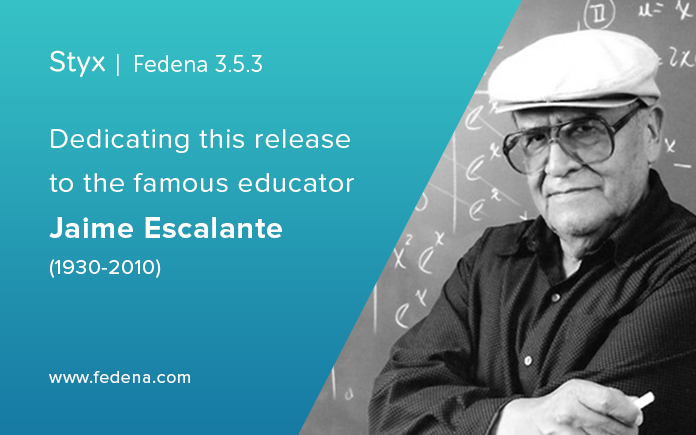
Styx : Fedena 3.5.3
Fedena 3.5.3 is live for our users around the world. This release comes with a new mode to calculate Loss of Pay in HR, Timetable PDF changes, a common sorting setting for all examination pages and a lot of small but useful changes. We are dedicating this release to a very famous Mathematics teacher from not very long ago. Jaime Escalante was born in La Paz, Bolivia in 1931 and started teaching there before moving to the United States in the1970s.

He started teaching at the James A Garfield High School, Los Angeles which had many Hispanic students of working class parents who were below their grade levels in terms of academic skills. He was determined to bring these children up in Mathematics and offered to teach AP Calculus. Changing the status quo was not easy and he faced a lot of criticism from the school authorities who complained he was coming early and staying late without permission. Not deterred by this, he continued teaching them advanced math and even proposed dropping the number of basic math classes. Eventually, he took his first calculus class and with the help of fellow teacher taught AP calculus to 5 students, two of whom passed. By 1981 this number increased to 14 out of a class of 15.
His popularity and success grew to such an extent that his students making it to the University of South California outnumbering the students from all schools in the East Los Angeles region combined. The life of Jaime Escalante was featured in the 1988 book Escalante: The Best Teacher in America and the 1988 Oscar nominated film Stand and Deliver. We leave you with a famous clip from the movie:
What’s new in Styx?
1. Loss of Pay Calculation mode
2. Examination Student sorting control
3. Feature access settings for Parent accounts
4. Notifications of Timetable swaps and cancel
What’s updated in Styx?
1. Generate receipts for pay all fees.
2. Partial payments can be done via online payments.
3. Pay all fees can now come with a default number and this can be changed when a partial payment is being done.
4. The Timetable format has changed to accommodate the entire batch on one single page.
5. Library data can now be exported using a CSV with additional data.
6. Transport module has been updated with reports specific to batches, courses, and routes.
7. The UI for student reports center has been updated for ease of use and access.
There have also been a number of issues fixed in this release, you can find them in the Fedena 3.5.3 Release notes.
Loss of Pay Calculation mode
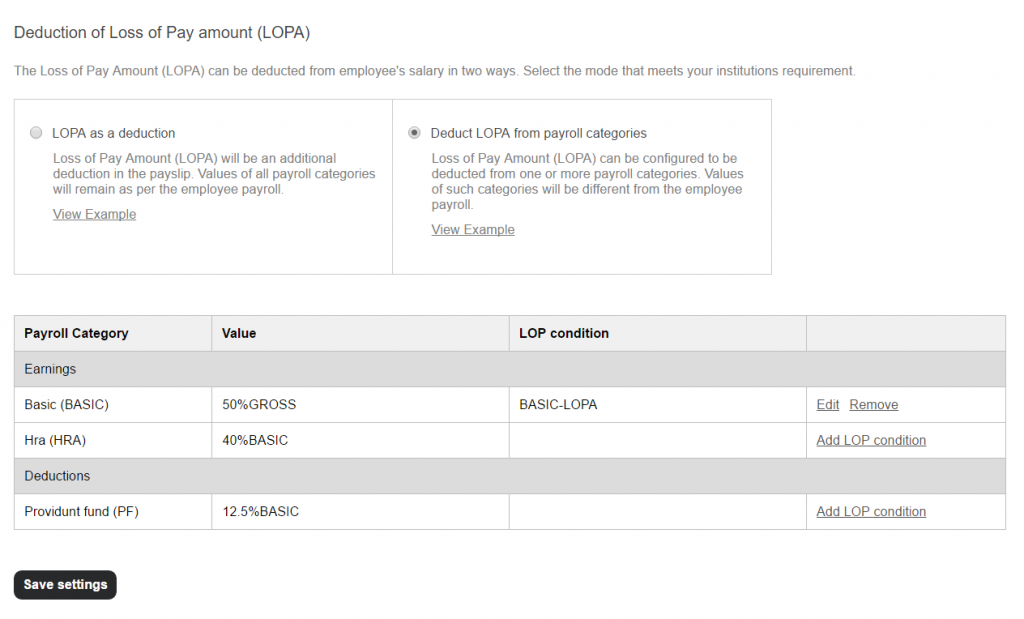
A new Loss of Pay (LOP) calculation mode – Deduct LOP from Payroll categories has been added to Payroll calculation. This mode allows deduction of LOP from one or more payroll categories instead of a direct deduction. For example:
Let’s consider a simple salary structure. The Basic Salary is 10,000 and Tax is 20% of Basic Salary. If the total working days are 20 and the employee having no leave takes 2 LOP days. The LOP can be configured in two ways now:
As a direct deduction
LOP is 1000
Basic Salary = 10,000
Tax = 2000
Loss of Pay = 1000
Net Salary = 7000
As a deduction from Payroll Categories
LOP = 1000
New Basic = 10000-1000 = 9000
Tax = 1,800
Net Salary = 7,200
While in Fedena you can find the option under payroll calculations, here’s a screenshot of the update.

Notifications for Timetable Swapping & Cancelling
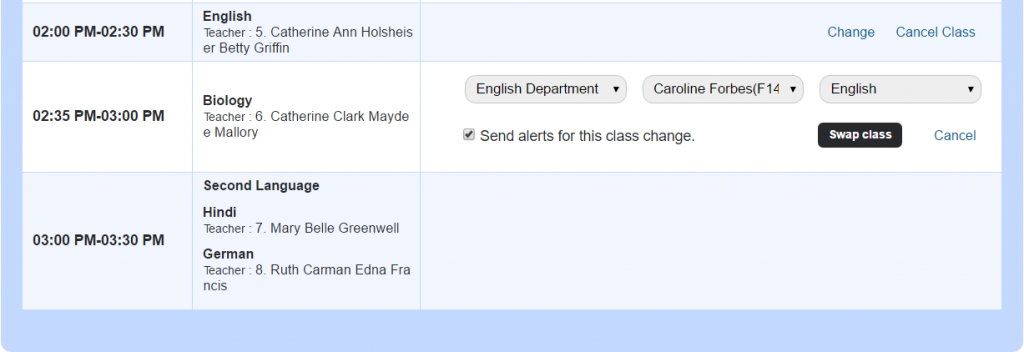
The timetable is the one document which holds power over all your teachers, students, and your school. It’s the one document which sets the pace for the whole academic year. In most schools and institutions the timetable is a dynamic document as it depends on the availability of teachers. Keeping this in mind, last time we had released a new feature of automatic timetabling and the ability to swap classes in the timetable to fill the unavailability of any teacher. With your feedback we realized that a notification when the swap occurs or a cancelation of a period occurs seemed to be highly important to reduce the confusion created in the school. We have added an automatic notification which goes out to teachers as well as students when a swap or a cancel is done in the timetable for the day, giving the information immediately to everybody involved with the class. The feature looks something like this:

What’s coming up?
Our team is already working on a host of new features that will enhance your experience with Fedena. A mobile application for admins, students and parents is getting rigged in our workshop. The features you have requested will soon be live in Fedena, the number one school management system.
Styx : Fedena 3.5.3 Release Notes

What’s new in Fedena
Here is the list of new features included with this release of Fedena 3.5.3
| Feature | Description | User Role | Module |
| Loss of Pay Calculation Mode | A new Loss of Pay (LOP) calculation mode – Deduct LOP from Payroll categories has been added to Payroll calculation. This mode allows to deduct LOP from one or more payroll categories instead of a direct deduction. | Administrator, Privileged Employee | Human Resources |
| Examination Student Sorting Control | This setting allows schools to fix the default sorting mechanism for students in the examination pages like mark entry, report cards etc. | Administrator, Privileged Employee | Examination |
| Feature access settings for parent account | A new feature access settings page allows to enable or disable new features from the parent accounts. | Administrator | General Settings |
| Notifications for timetable swap and cancel | Timetable swaps and cancels now have notifications that can be sent as Email, SMS and Internal Messages. Before confirming a swap or cancel you can. | Administrator, Privileged Employee | Timetable |
What’s enhanced in Fedena
Here is the list of enhanced features included with this release of Fedena 3.5.3
| Feature | Description | User Role | Module |
| Overall receipt for Pay all Fees | A new overall receipt PDF is available in Pay all Fees receipts. This single fee receipt is a summary of the fees that were collected during a single payment. For all fees collected, a single SMS is only sent. | Administrator, Privileged Employee | Finance |
| Online Fee payment settings to enable Partial Payment | This setting in Online Fee Payment allows school to enable or disable partial payment in a school. | Administrator, Privileged Employee | Online Payment |
| Pay all Fees enhancement | Pay all fees has a checkbox against each collection to have the amount pre filled or removed from it. Uncheck the checkbox to remove the prefilled amount and enter a partial amount. | Administrator, Privileged Employee, Student, Parent | Finance |
| Timetable PDF enhancement | Timetable PDF view now fits many subjects in a single page. This allows schools to print a timetable for the entire batch in a single page. PDF settings allows schools to control how the subject name is shown in the PDF. | Administrator, Privileged Employee, Student | Timetable |
| Library Export Books | Library books can be exported as CSV file along with the additional details of the book | Administrator, Privileged Employee | Library |
| Transport Reports | Transport module now has Batch, Department and Route wise reports | Administrator, Privileged Employee | Transport |
| Student Report Center UI enhancement | Student report center UI is improved to make it easier to understand and use. | Administrator, Privileged Employee, Student, Parent | Student |
Issues Fixed
Here is the list of issues fixed in this release of Fedena 3.5.3
Applicant Registration
- Fixed issue of duplicate transactions when approving applicants from multiple tabs
Examination
- Batch transferred student shows marks from previous batch without grade
- Permission issue in ICSE consolidated report when selecting the batch
Finance
- CSV report of batchwise Transport Fee Defaulters shows students from all batches
- Print summary not accessible from pay all fees of parent account
Library
- Issue with book number increment when book number with spaces used
Timetable
- Modal box throwing 500 error in the timetable summary page
- Issue in year selection at class room allocation
- Subject not loading in attendance register page
Settings
- Message count calculation for Multipart Messages
Transport
- Fee Due Amount incorrect displayed in the transport print receipt
- Transport privileged employee is unable to print the payment receipts
How Smart Schools Can Help Increase Inclusion
Classroom technology gives a voice to the ignored

A recent piece by Christina Thomas Dhanraj has reinvigorated the conversation around diversity in the workplace. Dhanraj speaks eloquently about the increasing presence of Dalit women in corporate spaces thanks to anti-discrimination laws and increasing awareness about corporate diversity and inclusion – largely a reflection of the policies of most multi-national offices.
The seeds of Dhanraj’s experience in corporate India are planted in our schools. Students from these communities are present, but that does not mean they are included.
In a previous blog ,we spoke about how increasing personalisation in curriculum leads to better learning for students. But what about diversity in the classroom? This continues to be a touchy subject, especially in a country like India, where increasing homogenisation is the preferred solution to differences. We are more focused on equal experiences rather than equitable experiences. This is a fallacy propagated by our desire to be fair and our solution to be as easy as it is quick. But a one size fits all solution rarely addresses the concerns of the most marginalised and seems to cater more to the majority, and often more privileged, group.
We live in a society where the hardest challenge faced by people across classes is social mobility. Education is seen as one of the few methods by which people are able to change their circumstances. Are students from marginalised communities receiving the best quality of education they could possibly receive?
A seminal study by Myra and David Sadker demonstrated that from kindergarten to grade school, women were often sidelined in classroom discussions, and consequently classroom learning. Research demonstrates that this experience is shared by students from other marginalised groups – delineated by caste, class, ethnicity, race, etc. While India-specific data is not as robust experiences shared by marginalised students reflects this bias. Silencing and social exclusion in the classroom undoubtedly affects the future professional personalities of our students.
One cannot discount the pressure on teachers in such a scenario. The most well-meaning of teachers struggle with the paucity of time and resources. Not only is this heart-rending for a teacher deeply invested in her student’s success, but it is also draining and stressful to feel like you’re constantly fighting a losing battle. While capabilities and support might be perennially limited, no compromises can be made when it comes to our children’s future.
So how can teachers effectively address exclusion? To start with, the deliberate inclusion of students is vital. Calling on a reticent student while is not the most pleasant experience for them and can often make them feel like they are being called out or put on the spot. This is why teaching techniques like the jigsaw method or learning by teaching are becoming increasingly popular. These methods encourage students to support their own and each others’ learning in low-pressure environments – through discussion in smaller groups or by gently encouraging them to take on empathetic leadership roles.
Technology can also be a helpful tool when it comes to democratising classroom participation. Fedena (our student management system) allows teachers and students to set up discussion groups – large and small – for a variety of reasons. Whether it be discussing a problem set for a homework assignment, or delving deeper into a discussion that began in history class, the social pressure of participating in classrooms is reduced. Students have the opportunity to formulate their point of view before “speaking” – giving them an opportunity to contribute insights they might not have had a chance to otherwise.
It is important to start having honest discussions and make deliberate efforts to address these issues. Learning technology is only an enabler – ultimately it is the willpower of educators and parents that will carry a student through.